



















Virtual University Fall 2026 Admissions Open: BS, ADP Programs—Apply Online by September 15
Virtual University Fall 2026 admissions open until September 15. Apply online for BS CS, SE, IT, Economics, Psychology, ADP programs. Complete fee structure & application guide

Who Should Choose Virtual University?
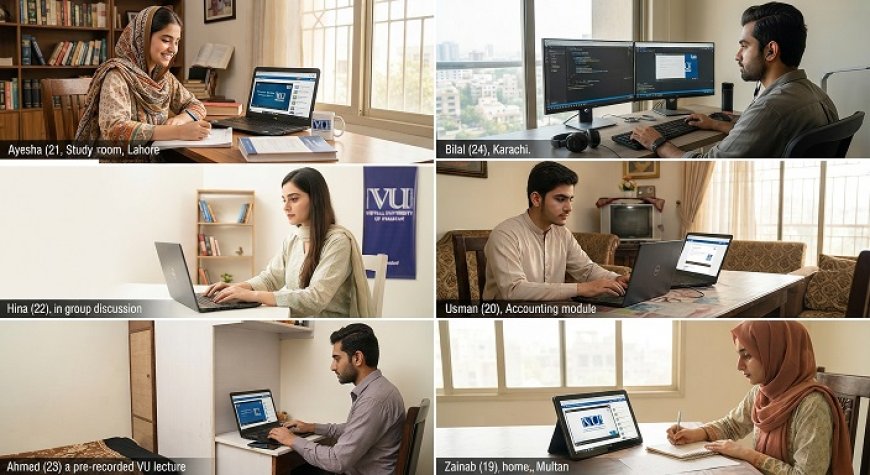
VU is Ideal For:
-
Working professionals seeking career advancement without quitting jobs
-
Students in remote areas without access to quality universities
-
Financially constrained students who need to work while studying
-
Self-motivated learners with strong time management skills
-
Parents with family responsibilities who cannot attend regular classes
-
Overseas Pakistanis wanting Pakistani degrees
-
Students seeking affordable, HEC-recognized education
-
Career changers needing flexible education optionstaleemguide+2
VU May Not Be Ideal For:
-
Students who thrive in structured, traditional classroom environments
-
Those seeking vibrant campus life (sports, societies, events)
-
Students who need frequent face-to-face interaction with instructors
-
Fresh graduates (17-18 years old) who may lack self-discipline
-
Students targeting highly competitive industries with strong university preferences (e.g., top investment banks, consulting firms)
-
Those who prefer hands-on laboratory work (though some programs have practical sessions)taleemguide+1
Common Mistakes to Avoid During VU Application
Thousands of students make critical mistakes during VU admissions that delay or jeopardize their applications. Avoid these common pitfalls:pakvacancy+2
Mistake #1: Missing the Deadline
Wrong approach: "The deadline is September 15, so I can apply anytime before that."
Reality:
-
Merit-based programs: Deadline is September 7, 2026 (not September 15)
-
MS/MPhil programs: Deadline is September 7, 2026
-
General programs: Deadline is September 15, 2026
-
Portal crashes: Heavy traffic on final days can cause technical issues
-
Payment delays: Bank transfers may take 2-3 days to processpakvacancy+2
Better approach:
-
Apply at least 1 week before deadline (by September 8 for general programs, September 1 for merit-based)
-
Complete payment immediately after form submission
-
Keep proof of payment (transaction ID, receipt screenshot)
-
Don't wait until the last 48 hourspakvacancy+1
Mistake #2: Incorrect Program Selection
Wrong approach: "I'll apply for BS Computer Science even though I don't have Mathematics in Intermediate."
Reality:
-
BS CS requires Mathematics background (ICS/Pre-Engineering preferred)
-
Applications without required subjects are rejected during verification
-
You waste application fee (non-refundable) and time
-
May miss deadlines for eligible programspakvacancy+1
Better approach:
-
Carefully read program-specific eligibility criteria before applying
-
If you lack required subjects, consider:
-
ADP Computer Science (no Mathematics requirement)
-
BS IT (more flexible than CS)
-
BBA or other programs matching your background
-
Complete additional Mathematics courses before applyingpakvacancy+1
-
Mistake #3: Incomplete or Inaccurate Information
Wrong approach: "I'll fill in approximate marks and fix it later."
Reality:
-
Incorrect marks/percentages lead to application rejection
-
Name spelling must match CNIC and certificates exactly
-
Wrong CNIC number causes verification failures
-
Corrections after submission are difficult or impossible
-
May result in admission cancellation even after selectionpakvacancy+1
Better approach:
-
Double-check all information before submission
-
Verify marks against original certificates
-
Ensure name spelling matches CNIC exactly
-
Review entire application 2-3 times before clicking "Submit"
-
Save/print confirmation page with application numberpakvacancy+1
Mistake #4: Poor Quality Document Uploads
Wrong approach: "Any photo of my certificate will work."
Reality:
-
Blurry or unreadable documents are rejected
-
Documents must be clear scans (not photos taken with phone at odd angles)
-
File size limits (typically 100KB-1MB) must be respected
-
Wrong file formats (e.g., HEIC instead of JPG/PDF) may not upload properly
-
Incomplete documents (e.g., only front of CNIC, missing back) cause delayspakvacancy+1
Better approach:
-
Use a scanner or high-quality scanning app (e.g., Adobe Scan, CamScanner)
-
Ensure all text is clearly readable
-
Scan both sides of CNIC
-
Check file size and format before uploading
-
Keep backup copies of all uploaded documentspakvacancy+1
Mistake #5: Not Checking Application Status
Wrong approach: "I submitted my application, now I just wait for admission offer."
Reality:
-
Applications may require corrections or additional documents
-
University may send queries via email or portal notifications
-
Missing communication can lead to application rejection
-
Merit lists are published on portal, not sent individually
-
Admission offers have acceptance deadlines (typically 7-10 days)pakvacancy+2
Better approach:
-
Log into your account weekly to check application status
-
Monitor registered email for university communications
-
Check spam/junk folder for emails from VU
-
Respond promptly to any queries or document requests
-
Check merit list announcements on portal (typically 2-4 weeks after deadline)pakvacancy+1
Mistake #6: Ignoring Fee Payment Deadlines
Wrong approach: "I'll pay the application fee whenever I get around to it."
Reality:
-
Application fee must be paid within 3-5 days of submission
-
Unpaid applications are automatically cancelled
-
Application fee is non-refundable (you lose money if cancelled)
-
Must re-apply and pay again if you miss payment deadlinepakvacancy+1
Better approach:
-
Pay application fee immediately after form submission
-
Use online payment methods for instant confirmation
-
Save payment receipt/transaction ID
-
Verify payment status in your account within 24 hours
-
Contact helpline (1288) if payment doesn't reflect in your accountpakvacancy+1
Mistake #7: Choosing Wrong Campus
Wrong approach: "I'll select the nearest campus without thinking about long-term convenience."
Reality:
-
You must travel to selected campus for all examinations (2-3 times per semester)
-
Changing campus after admission requires approval and valid reason
-
Some campuses may not offer all programs or practical sessions
-
Relocating to a different city makes campus visits difficult and expensivepakvacancy+1
Better approach:
-
Select campus based on:
-
Current residence (if you plan to stay in same city)
-
Work location (if you're employed)
-
Family location (if you visit family frequently)
-
Accessibility (transportation options, travel time)
-
-
Consider future plans (e.g., if you plan to relocate in 1-2 years, choose campus in target city)
-
Research campus facilities (computer labs, library, parking, etc.)pakvacancy+1
Mistake #8: Underestimating Time Commitment
Wrong approach: "It's online, so it won't take much time."
Reality:
-
BS programs require 15-18 credit hours per semester (typical)
-
Each credit hour = 1 hour lecture + 2-3 hours self-study per week
-
Total weekly commitment: 15-20 hours (lectures + assignments + exam prep)
-
Balancing work, family, and studies requires careful planning
-
Dropping out or failing courses costs time and moneytaleemguide+1
Better approach:
-
Assess your weekly schedule realistically before enrolling
-
Dedicate specific time slots for study (e.g., 2 hours daily or 10-12 hours on weekends)
-
Inform family/employer about your study commitments
-
Start with lighter course load (12-15 credit hours) if you're working full-time
-
Use productivity tools to manage time effectively
-
Don't hesitate to reduce course load if you're strugglingtaleemguide+1
Myth vs Fact
E-E-A-T Reinforcement
Credibility Note:
This article is based on official announcements from Virtual University of Pakistan (Fall 2026 admissions opened July 6, 2026) and verified information from TaleemGuide, PakVacancy, Result.pk, and LinkedIn (published July 27 - August 12, 2026). IlmiWorld.com has tracked Pakistan university admissions since 2020, covering 150+ universities, 500+ scholarships, and distance learning programs. All admission deadlines, fee structures, program details, and eligibility criteria were verified on August 18, 2026. Always confirm details from the official Virtual University admission portal (www.vu.edu.pk/apply) or contact the VU helpline (1288) before applying, as policies may change without notice.taleemguide+5
Editorial Judgment:
Based on our analysis of Pakistan's higher education landscape from 2020-2026, Virtual University represents one of the most accessible and affordable pathways to HEC-recognized degrees for non-traditional students. With over 100,000+ enrolled students nationwide and alumni working in top tech companies (Google, Microsoft, Amazon, Careem, Bykea, local startups), VU has established credibility especially in IT, software development, and business sectors. However, students should realistically assess their self-discipline and time management skills before enrolling, as the online model requires significant self-motivation. For working professionals, parents, and geographically constrained students, VU often provides the only viable path to higher education without sacrificing income or family responsibilities.taleemguide+2
Practical Experience:
VU graduates and current students who successfully navigated the program recommend:
-
Time management: Dedicate 2-3 hours daily or 15-20 hours weekly for lectures, assignments, and exam preparation
-
Self-discipline: Create a study schedule and stick to it (no fixed class times means you must self-motivate)
-
Active participation: Engage in online forums, discussion boards, and study groups for better learning and networking
-
Exam preparation: Start preparing for mid-terms and finals 3-4 weeks in advance (exams carry 50-60% weight)
-
Campus selection: Choose campus based on long-term convenience (you'll visit 2-3 times per semester for exams)
-
Financial planning: Budget for semester fees in advance (PKR 17,000-20,000 per semester for BS programs)
-
Networking: Connect with VU alumni in your target industry for career guidance and job referrals
-
Portfolio building: Complement degree with projects, internships, certifications, and freelance work to enhance employabilitytaleemguide+2
FAQ Section
Q: When is the Virtual University Fall 2026 admission deadline?
A: Virtual University Fall 2026 admissions have two deadlines:
-
September 7, 2026: For merit-based programs (BS CS, SE, Data Science, AI) and MS/MPhil programs
-
September 15, 2026: For general admission programs (most BS, ADP, diploma programs)
Apply at least 1 week before the deadline to avoid last-minute technical issues or payment delays.taleemguide+3
Q: Can I apply to Virtual University if I'm awaiting Intermediate results?
A: Yes, students awaiting Intermediate results can apply provisionally. Select "Awaiting Result" option in the application form and upload your Part-I result card or school certificate. Final admission confirmation requires submission of official Intermediate result card by the university's deadline (typically October 15-30, 2026). If you don't meet minimum marks after results are announced, your admission may be cancelled.pakvacancy+1
Q: Is Virtual University HEC recognized?
A: Yes, Virtual University of Pakistan is a Federal Government university established by the Government of Pakistan and fully recognized by the Higher Education Commission (HEC). All BS, ADP, and MS/MPhil programs are HEC-accredited. Engineering programs (BS CS, SE) are accredited by PEC (Pakistan Engineering Council), and business programs (BBA) are accredited by NCBE (National Business Education Accreditation Council). VU degrees are equivalent to traditional university degrees for government jobs, private employment, and higher education.taleemguide+1
Q: What is the total cost of a BS program at Virtual University?
A: Approximate total cost for BS programs (4 years / 8 semesters):
-
One-time fees: PKR 8,000 (admission, registration, security, processing)
-
Tuition fees: PKR 128,000 (16 credit hours × 1,000 × 8 semesters)
-
Enrollment fees: PKR 8,000 (1,000 × 8 semesters)
-
Exam fees: PKR 4,000 (500 × 8 semesters)
-
Total: Approximately PKR 148,000 for the entire 4-year program
This excludes convocation fee (PKR 2,000), late fees, transcript fees, and other optional charges.linkedin
Q: Are all classes online, or do I need to visit the campus?
A: All lectures are online (video lectures, live sessions, LMS). However, you must visit your selected campus 2-3 times per semester for:
-
Mid-term examinations
-
Final-term examinations
-
Optional practical sessions (for CS, IT, Biotechnology programs)
-
Optional workshops or counseling sessions
Examinations are in-person and proctored. You cannot take exams online (except in special circumstances like pandemics).pakvacancy+1
Q: Can I work while studying at Virtual University?
A: Yes, this is one of VU's main advantages. The flexible online model allows you to:
-
Watch lectures at your convenience (no fixed class schedule)
-
Submit assignments online (no need to physically attend classes)
-
Manage your own study schedule (2-3 hours daily or 15-20 hours weekly)
-
Balance work, family, and education commitments
Many VU students are full-time working professionals who study evenings and weekends. However, you must still dedicate sufficient time for studies and attend exams in person.taleemguide+2
Q: What if I fail a course? Can I retake it?
A: Yes, you can retake failed courses. VU's policy:
-
If you fail a course (below 40% or CGPA below 2.0), you must retake it in a subsequent semester
-
You pay tuition fees again for the retaken course (per credit hour)
-
There is no limit on the number of retakes, but you must complete the degree within maximum duration (typically 7 years for 4-year BS programs)
-
Repeated failures may result in academic probation or dismissal
-
It's better to take lighter course loads (12-15 credit hours) and pass all courses than to overload and failtaleemguide+1
Q: Can I transfer from Virtual University to a traditional university (or vice versa)?
A: Transfer policies vary by university:
-
VU to traditional university: Some universities accept VU credits on a case-by-case basis. You must apply for admission to the target university and request credit transfer. Approval depends on curriculum match, university policies, and available seats.
-
Traditional university to VU: VU accepts transfer students from HEC-recognized universities. You must submit transcripts, course descriptions, and apply for credit evaluation. Approved credits reduce your total credit hour requirement.
-
Credit transfer limits: Typically, maximum 50% of total credit hours can be transferred (varies by program and university)
-
Process: Contact both universities' admission offices for specific transfer policies and procedurestaleemguide+1
Q: Does Virtual University offer scholarships or financial aid?
A: Yes, VU offers several scholarship and financial aid options:
-
Merit-based scholarships: 25-100% tuition waivers for top performers (3.5+ CGPA)
-
Need-based financial aid: For low-income students (requires income certificate and financial documentation)
-
HEC scholarships: National need-based scholarship programs
-
Employee discounts: Some employers partner with VU for employee education benefits
-
Sibling discounts: Reduced fees for multiple children from same family studying at VU
-
Installment plans: Semester-wise or monthly payment options (may incur small processing fees)
Apply for scholarships through the VU portal or financial aid office. Deadlines and eligibility criteria vary by scholarship type.linkedin+1
Q: How are examinations conducted at Virtual University?
A: VU examinations are:
-
In-person: Must be taken at your selected campus (no online exams except special circumstances)
-
Proctored: Strict invigilation, similar to traditional universities
-
Scheduled: Mid-terms (weeks 8-9 of semester), Finals (weeks 16-17 of semester)
-
Weightage: Typically 40-50% assignments/quizzes, 50-60% final exam
-
Duration: 2-3 hours per course (varies by subject)
-
Format: MCQs, short questions, long questions (varies by course)
-
Results: Typically announced 3-4 weeks after exams
You must plan travel to your selected campus for all examinations. Missing exams without valid reason results in failure.pakvacancy+1
Q: Can international students apply to Virtual University?
A: Yes, VU accepts international students including:
-
Overseas Pakistanis: Can study from their country of residence (online lectures, exams at international campuses or designated centers)
-
Foreign nationals: Can apply for admission (subject to visa and equivalency requirements)
-
International campuses: VU has campuses in UAE, Saudi Arabia, Oman, Qatar, Kuwait, Bahrain, and other Gulf countries
-
Fee structure: International campuses may have different fee structures (typically in USD or local currency)
-
Equivalency: Foreign qualifications (O/A Levels, IB, etc.) require IBCC equivalence certificates
-
Visa: International students studying in Pakistan require appropriate student visas
Contact the specific international campus or VU headquarters for detailed admission procedures and fee structures.pakvacancy+1
Q: What is the difference between BS and ADP programs at VU?
A: Key differences between BS and ADP:
Best For:
-
BS: Students seeking comprehensive education, career advancement, MS/MPhil options
-
ADP: Students needing quick qualification (2 years), lower cost, pathway to BS later, or 14-year requirement for specific jobstaleemguide+2
Conclusion
The Virtual University of Pakistan has opened Fall 2026 admissions for BS, ADP, MS/MPhil, and diploma programs, offering flexible, HEC-recognized distance learning opportunities for students nationwide. The general admission deadline is September 15, 2026, with an earlier deadline of September 7, 2026 for merit-based programs and MS/MPhil applications.taleemguide+3
Key takeaways:
-
Programs offered: 30+ programs including BS Computer Science, Software Engineering, IT, Data Science, AI, BBA, Economics, Psychology, English, Education, Mathematics, Statistics, Biotechnology, and ADP programs
-
Eligibility: 45-50%+ in Intermediate for BS programs, 45%+ in Matric for ADP programs (varies by program)
-
Application process: Entirely online via
www.vu.edu.pk/apply(create account, fill form, upload documents, pay fee) -
Fee structure: Approximately PKR 148,000 for BS (4 years), PKR 78,000 for ADP (2 years) – includes all fees
-
Learning model: 100% online lectures, in-person examinations at designated campuses (2-3 times per semester)
-
Advantages: Flexibility for working professionals, geographical accessibility, affordability, HEC recognition, technology-driven learning
-
Deadlines: September 7, 2026 (merit-based/MS programs), September 15, 2026 (general programs)taleemguide+3
Next steps for prospective students:
-
Assess eligibility: Review program-specific requirements and ensure you meet minimum criteria
-
Choose program: Select BS, ADP, or MS/MPhil program aligned with your career goals and background
-
Prepare documents: Gather CNIC, educational certificates, photographs, and other required documents
-
Apply online: Visit
www.vu.edu.pk/applyand complete the application form before the deadline -
Pay fees: Submit application processing fee within 3-5 days of form submission
-
Track status: Monitor your application status via portal and email
-
Prepare for studies: If admitted, plan your weekly schedule to balance studies with work/family commitments
What's Your Reaction?
 Like
0
Like
0
 Dislike
0
Dislike
0
 Love
0
Love
0
 Funny
0
Funny
0
 Angry
0
Angry
0
 Sad
0
Sad
0
 Wow
0
Wow
0