





















MDCAT 2026: PMDC Exam Date, Revised Syllabus, Pattern and Registration Guide
MDCAT 2026 date and syllabus update by PMDC. Check exam pattern, registration via UHS and provincial agencies, and a 30-day revision plan for MBBS and BDS.


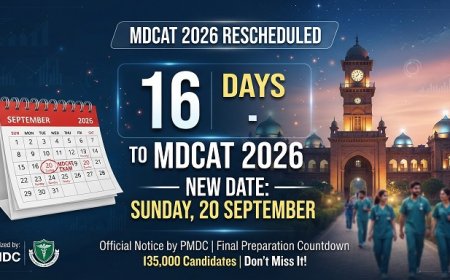
The Pakistan Medical and Dental Council (PMDC) has confirmed the official date and revised syllabus structure for the 2026 MDCAT, the national entry test for MBBS and BDS admissions. Medical aspirants across Pakistan must complete their registration through designated provincial testing authorities (such as UHS in Punjab) and align their preparation with the updated PMDC syllabus.beambeprep+1
This matters for:
-
FSc Pre-Medical and A-Level students aiming for MBBS and BDS seats in public and private medical/dental colleges
-
Candidates who need a clear view of the exam pattern, subject weightage, and registration steps
-
Students who must reset their preparation timeline based on the announced MDCAT 2026 date
In this guide, you’ll get:
-
Confirmed MDCAT 2026 framework under PMDC (pattern, subjects, marking)tabiracademy+3
-
Item-by-item syllabus breakdown (Biology, Chemistry, Physics, English, Logical Reasoning)tabiracademy+2
-
Step-by-step registration process via UHS and other provincial portals
-
A realistic 30-day revision blueprint tailored to the MDCAT pattern
-
FAQs that match real student searches
Note: The exact 2026 test date and any year-specific syllabus tweaks must be verified on pmdc.pk and your provincial admitting university’s website (e.g., UHS for Punjab).beambeprep+1
What Has PMDC Announced for MDCAT 2026?
PMDC sets the national syllabus and minimum standards for MDCAT, while provincial admitting bodies (e.g., UHS Lahore, KMU Peshawar, DUHS Karachi, ETEA in some contexts) conduct the test and manage registration.beambeprep+1
For 2026, PMDC’s framework includes:
-
Test name: MDCAT (Medical and Dental Colleges Admission Test)
-
Purpose: Entry test for MBBS and BDS programmes in Pakistantabiracademy+1
-
Conduct: Provincial admitting universities/agencies under PMDC’s syllabus and policiesbeambeprep+1
-
Format: MCQ-based, typically no negative marking in recent cyclestabiracademy+1
-
Core subjects:
-
Biology
-
Chemistry
-
Physics
-
English
-
Logical Reasoningtabiracademy+3
-
PMDC has also reaffirmed the national merit formula used by most provinces:
The official 2026 test date and any specific syllabus adjustments are announced via PMDC and provincial portals; students must check pmdc.pk and their provincial admitting university’s site for the final schedule.beambeprep+1
MDCAT 2026 Exam Pattern and Structure
Based on the current PMDC-aligned MDCAT design and 2026 prep resources:
-
Question type: Multiple Choice Questions (MCQs)
-
Total questions: Commonly 200 MCQs in recent cycleshighyield
-
Duration: Typically 210 minutes (3 hours 30 minutes)highyield
-
Negative marking: Generally not applied in recent MDCAT cycles; confirm in your 2026 admit card instructionstabiracademy+1
-
Language: English (for all subjects)
Subject-Wise Weightage (Typical PMDC-Aligned Pattern)
While exact question counts can vary slightly by province and year, the weightage pattern is consistent:
Exact 2026 question distribution and time allocation will be specified in the provincial admission advertisement and admit card.tabiracademy
MDCAT 2026 Syllabus: Item-by-Item Breakdown
The PMDC national syllabus covers FSc Pre-Medical (or equivalent) content. Below is a practical breakdown aligned with recent MDCAT guides and 2026 prep materials.tabiracademy+3
Biology (Highest Weight)
Focus areas typically include:
-
Cell structure and function
-
Biological molecules (carbohydrates, proteins, lipids, nucleic acids)
-
Enzymes (mechanism, factors affecting activity)
-
Bioenergetics (photosynthesis, respiration)
-
Prokaryotes and viruses
-
Diversity of life (kingdoms, classification)
-
Life processes in plants and animals (transport, nutrition, gas exchange, homeostasis)
-
Support and movement (skeletal, muscular systems)
-
Coordination and control (nervous and endocrine systems)
-
Reproduction and development
-
Genetics and inheritance (Mendelian and non-Mendelian, molecular genetics)
-
Evolution
-
Biotechnology (recombinant DNA, PCR, cloning, applications)
-
Ecology and environment
Biology is largely recall-based from the FSc textbook; line-by-line preparation is highly rewarding.tabiracademy
Chemistry (Second-Highest Weight)
Key domains:
-
Physical Chemistry:
-
Stoichiometry
-
Atomic structure
-
Chemical bonding
-
States of matter (gases, liquids, solids)
-
Chemical equilibrium
-
Acids, bases, and salts
-
Reaction kinetics
-
Thermochemistry
-
Electrochemistry
-
-
Organic Chemistry:
-
Fundamental concepts (hybridization, isomerism, reaction mechanisms)
-
Alkanes, alkenes, alkynes
-
Benzene and aromatic compounds
-
Alkyl halides
-
Alcohols, phenols, ethers
-
Aldehydes and ketones
-
Carboxylic acids and derivatives
-
Amines
-
Biomolecules (carbohydrates, proteins, lipids)
-
-
Inorganic Chemistry:
-
Periodic trends
-
s-block and p-block elements
-
Transition elements
-
Industrial chemistry (basic processes)
-
Emphasis is on conceptual clarity plus practice of numericals in physical chemistry.tabiracademy
Physics (Substantial Weight)
Core topics:
-
Measurements and uncertainties
-
Vectors and equilibrium
-
Motion and force (kinematics, dynamics)
-
Work, energy, and power
-
Circular motion and gravitation
-
Fluid dynamics
-
Oscillations and waves
-
Sound
-
Optics (geometrical and physical optics)
-
Thermal physics (heat, thermodynamics)
-
Electrostatics
-
Current electricity
-
Electromagnetism
-
Electromagnetic induction and AC
-
Modern physics (atomic, nuclear, radiation, basic electronics)
Focus on short, applied numericals and formula-based MCQs.tabiracademy+1
English (Smaller but Score-Critical)
Typical areas:
-
Grammar: tenses, subject-verb agreement, articles, prepositions
-
Sentence structure: correction, completion, transformation
-
Vocabulary: synonyms, antonyms, context-based meaning
-
Comprehension: short passages with inferential questions
English is a key differentiator when Biology/Chemistry/Physics scores are clustered.tabiracademy+1
Logical Reasoning (Smallest Block, High ROI)
Common question types:
-
Sequences and series (number, letter, alphanumeric)
-
Analogies
-
Classification and odd-one-out
-
Basic deductive/inductive reasoning
-
Simple analytical puzzles
With focused practice, this section can yield quick, reliable marks.tabiracademy+1
MDCAT 2026 Registration Process (UHS and Other Provincial Bodies)
Registration is managed by provincial admitting universities/agencies, not directly by PMDC.beambeprep+1
Step 1: Confirm Your Domicile and Target Province
-
Punjab: UHS Lahore (for most public/private colleges in Punjab)
-
KPK: KMU Peshawar (and potentially ETEA in future cycles)dawn+3
-
Sindh: DUHS Karachi / other designated Sindh bodies
-
Balochistan: Bolan University of Medical Sciences (BUMS) or designated body
-
AJK & Gilgit-Baltistan: As notified by PMDC and respective authorities
Your domicile usually determines which provincial portal you must use.
Step 2: Check Eligibility
Typical requirements:
-
FSc Pre-Medical (or equivalent) with required minimum marks (as per PMDC and provincial rules)
-
A-Level students: Must have HEC equivalence certificate
-
Age limit: As defined by PMDC/province (if applicable)
-
Nationality: Pakistani nationals, overseas Pakistanis, and foreign seats as per policy
Step 3: Create an Account on the Provincial Portal
Examples:
-
Punjab (UHS):
uhs.edu.pk→ MDCAT admission section -
KPK (KMU/ETEA transition): Monitor
kmu.edu.pkand ETEA noticesdawn+3 -
Sindh (DUHS):
duhs.edu.pk
Register with:
-
CNIC
-
Email
-
Mobile number
Step 4: Fill the MDCAT Application Form
Provide:
-
Personal details (name, father’s name, CNIC, domicile)
-
Academic details (Matric/SSC, FSc/A-Level marks, boards, years)
-
Category (open merit, provincial quota, overseas, foreign, etc.)
Step 5: Pay the MDCAT Processing Fee
-
Fee amount is set by the provincial body (varies by province and category).
-
Payment via:
-
Bank challan (designated branches)
-
Online payment (if available)
-
Keep the paid challan/receipt.
Step 6: Upload Required Documents
Commonly required:
-
CNIC (student) and father/guardian CNIC
-
Domicile certificate
-
Matric/SSC certificate and mark sheet
-
FSc Part 1 and Part 2 mark sheets (or appearing certificate, if allowed)
-
A-Level equivalence certificate (if applicable)
-
Recent passport-size photograph
-
Any additional forms specified by the provincial authority
Step 7: Submit and Print Application
-
Review all entries carefully
-
Submit before the provincial deadline
-
Download/print the application receipt
Step 8: Download Admit Card / Roll Number Slip
-
Typically available 1–2 weeks before the test on the provincial portaltabiracademy
-
Contains:
-
Test date and time
-
Test centre address
-
Instructions (what to bring, prohibited items, etc.)
-
Step 9: Appear in MDCAT 2026
-
Bring:
-
Original CNIC/B-form
-
Printed admit card/roll number slip
-
Any other required documents (as per instructions)
-
Step 10: Check Result and Merit Lists
-
Results are published by the provincial body.
-
Aggregate is calculated using the PMDC formula (10% Matric, 40% FSc, 50% MDCAT) for most provinces.tabiracademy
-
Merit lists are then issued for MBBS and BDS admissions.
30-Day MDCAT 2026 Revision Blueprint (Realistic Plan)
Assuming the MDCAT 2026 date falls in the typical September–October window, this plan helps students reset preparation efficiently.tabiracademy
Week 1: Syllabus Mapping + Biology Heavy Lift
Goals:
-
Map entire syllabus to your notes/textbooks
-
Complete one full pass of Biology (highest weight)
Daily structure (6–8 hours):
-
Biology: 3–4 hours (2 chapters/day, with MCQs)
-
Chemistry: 2 hours (1 physical + 1 organic topic)
-
Physics: 1.5 hours (1–2 topics, formula sheet + MCQs)
-
English + Logical Reasoning: 30–45 minutes (grammar drills + 10–15 reasoning MCQs)
End of Week 1:
-
Finish all Biology chapters at least once
-
Create a “weak topics” list for each subject
Week 2: Chemistry + Physics Core + Mixed MCQs
Goals:
-
Strengthen Physical Chemistry and Mechanics/Electricity in Physics
-
Start mixed-subject MCQ sets
Daily structure:
-
Chemistry: 2.5 hours (numericals + reaction mechanisms)
-
Physics: 2.5 hours (numericals + concept MCQs)
-
Biology: 2 hours (revision of weak chapters + MCQs)
-
English + Logical Reasoning: 45 minutes
End of Week 2:
-
Complete core Physical Chemistry and key Physics units
-
Have at least 3–4 full-length subject-wise MCQ sets done
Week 3: Full-Length Mocks + Error Log
Goals:
-
Build exam stamina and timing
-
Identify persistent error patterns
Plan:
-
3 full-length mocks (200 MCQs, 210 minutes each) on alternate dayshighyield
-
On non-mock days:
-
Review incorrect and guessed questions
-
Revise weak topics from error log
-
Light Biology recall (diagrams, definitions, cycles)
-
Daily structure on mock days:
-
1 full mock (timed, exam-like conditions)
-
2–3 hours of detailed review and targeted revision
End of Week 3:
-
Clear idea of your likely score range
-
Refined strategy for section order and time allocation
Week 4 (Final 7 Days): Targeted Revision + Light Practice
Goals:
-
Consolidate high-yield facts
-
Avoid burnout
Plan:
-
Days 1–4:
-
Biology: rapid revision of all chapters (notes, highlights, key MCQs)
-
Chemistry: organic reactions summary, key physical formulas
-
Physics: formula sheet, common MCQ traps
-
English + Logical Reasoning: short daily drills
-
-
Days 5–6:
-
1–2 shorter mocks (100–150 MCQs) or section-wise timed sets
-
Focus on accuracy, not new content
-
-
Day 7 (day before exam):
-
Light review only (formulas, definitions, key diagrams)
-
No heavy solving; ensure rest and sleep
-
Passing Marks and Merit Expectations for MDCAT 2026
PMDC sets minimum passing marks for MDCAT; these have been adjusted in past cycles to balance seat availability and candidate performance.academiamag
-
Passing marks: Defined by PMDC each year; check the 2026 notice on
pmdc.pk. -
Competitive scores: For MBBS in top public colleges, successful candidates often score significantly above the minimum passing threshold.
Remember, admission depends on the aggregate:
Even a 5–10 mark increase in MDCAT can shift your aggregate by 2.5–5 percentage points, which can be decisive in merit lists.
Myth vs Fact
Myth: MDCAT is only about memorizing Biology.
Fact: While Biology has the largest weight, Chemistry and Physics together form a major portion, and strong performance in all three is essential for top merit.tabiracademy+1
Myth: Logical Reasoning and English don’t matter much.
Fact: These smaller sections can be high-return; a few extra marks here can significantly improve your aggregate rank.tabiracademy+1
Myth: PMDC directly handles MDCAT registration for all provinces.
Fact: PMDC sets the syllabus and policies, but registration and test conduct are managed by provincial bodies (e.g., UHS, KMU, DUHS).beambeprep+1
E-E-A-T Reinforcement (Credibility Note)
This article is based on the PMDC’s national MDCAT framework and widely published 2026 MDCAT guidance, including subject coverage, pattern, and provincial registration processes. We prioritise official PMDC and provincial admitting university sources for all dates and rules. For final confirmation, always refer to:beambeprep+4
-
PMDC:
https://pmdc.pk -
Your provincial admitting university (e.g., UHS:
uhs.edu.pk)beambeprep+1
FAQ Section
1. What is the MDCAT 2026 exam date?
PMDC has confirmed the 2026 MDCAT date; the exact test day is published on pmdc.pk and provincial portals (e.g., UHS for Punjab).beambeprep+1
2. Who conducts MDCAT 2026?
PMDC sets the syllabus and policies, but provincial admitting bodies (UHS, KMU, DUHS, etc.) conduct the test and manage registration.beambeprep+1
3. What is the MDCAT 2026 syllabus?
The syllabus covers FSc Pre-Medical content in Biology, Chemistry, Physics, English, and Logical Reasoning as defined by PMDC.tabiracademy+3
4. How many MCQs are in MDCAT and what is the duration?
MDCAT typically has 200 MCQs with a duration of 210 minutes (3 hours 30 minutes); confirm the exact 2026 pattern in your admit card.highyield
5. Is there negative marking in MDCAT 2026?
Recent MDCAT cycles have not applied negative marking; verify this in the 2026 test instructions.tabiracademy+1
6. How is MDCAT merit calculated for MBBS and BDS?
Most provinces use: 10% Matric + 40% FSc/A-Level + 50% MDCAT to compute the aggregate for merit lists.tabiracademy
7. Can A-Level students apply for MDCAT 2026?
Yes, with an HEC equivalence certificate and fulfillment of PMDC and provincial eligibility criteria.
8. How do I register for MDCAT 2026?
Through your provincial admitting university’s portal (e.g., UHS for Punjab), not directly via PMDC.beambeprep+1
9. What is the passing marks for MDCAT 2026?
PMDC sets the minimum passing marks each year; check the official 2026 notice on pmdc.pk.academiamag
10. How can I prepare for MDCAT in 30 days?
Follow a structured plan: full Biology pass in Week 1, core Chemistry/Physics in Week 2, full-length mocks in Week 3, and targeted revision in Week 4, as outlined in this article.tabiracademy+1
Conclusion
MDCAT 2026 is the gateway to MBBS and BDS seats across Pakistan, with PMDC defining the syllabus and provincial bodies managing registration and test conduct. With the exam date announced and syllabus structure clarified, students should immediately align their preparation to the PMDC pattern, register on time via their provincial portal, and use a focused 30-day plan to maximize their score.beambeprep+3
What's Your Reaction?
 Like
0
Like
0
 Dislike
0
Dislike
0
 Love
0
Love
0
 Funny
0
Funny
0
 Angry
0
Angry
0
 Sad
0
Sad
0
 Wow
0
Wow
0