
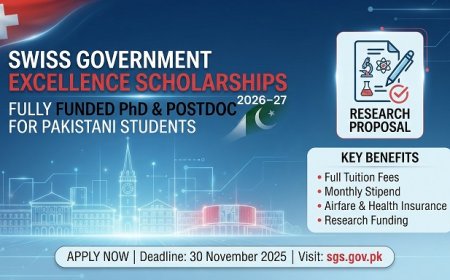













Swiss Government Excellence Scholarships 2026–27 for Pakistani Students: Fully Funded PhD and Postdoc Opportunities
Swiss Government Excellence Scholarships 2026–27 open for Pakistani PhD and postdoc applicants. Check eligibility, stipend, deadlines and how to apply.

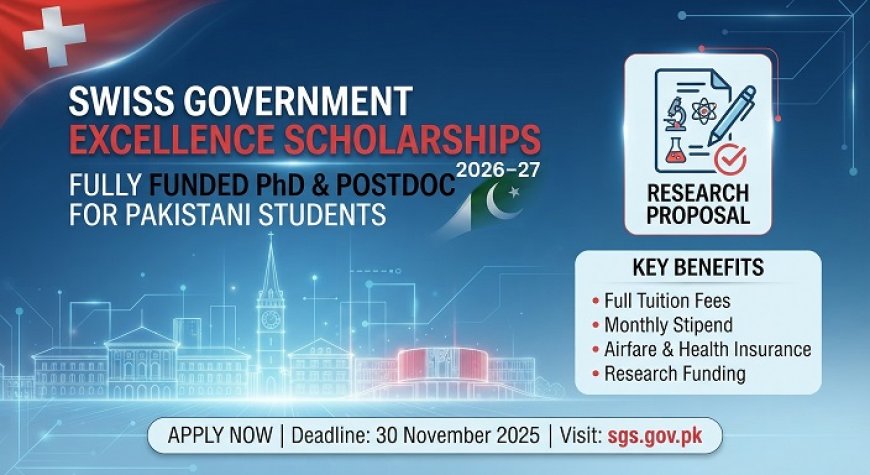
Short answer: The Swiss Government Excellence Scholarships 2026–27 cycle is open for international applicants, including Pakistani researchers and postgraduate students, with fully funded PhD, postdoctoral and research fellowship awards at Swiss universities and research institutes; selection is highly competitive and hinges on academic excellence, a strong research proposal and a confirmed Swiss supervisor’s support.studyinternational+2
For Pakistani students, this is one of Europe’s most prestigious fully funded routes to a PhD or advanced research stay, but it is not a last‑minute scholarship: you must identify a supervisor, craft a credible research plan and meet strict eligibility and deadline rules.studyinternational+2
What you’ll get in this guide:
-
Who can apply (eligibility by degree, age, prior Switzerland stays)flexjobspace+1
-
What the scholarship covers (stipend, insurance, travel, housing allowance)y-axis+1
-
The four scholarship types (PhD, postdoc, research fellowship, art) and who they suitstudyinternational+1
-
Step‑by‑step application process (supervisor contact, proposal, portal, embassy deadline)flexjobspace+2
-
Why many Pakistani applications fail and how to write a winning research proposal
-
FAQs that match real search queries from Pakistani MS/PhD aspirants
Who is eligible for Swiss Government Excellence Scholarships 2026–27?
One-sentence summary: The scheme targets outstanding international researchers who already hold a Master’s (or equivalent) and meet age, academic and Switzerland‑stay conditions, with different rules for PhD, postdoc and research fellowships.flexjobspace+2
Core eligibility points (typical for PhD and research fellowships):
-
Degree requirement: You must have a Master’s degree or equivalent by the cutoff date set for the cycle (commonly by 31 July 2027 for 2027–28 start).flexjobspace
-
Academic level:
-
PhD scholarships: for applicants who have completed a Master’s and wish to pursue doctoral studies at an eligible Swiss institution.studyinternational+1
-
Postdoctoral scholarships: for early‑career researchers with a PhD (or equivalent) seeking advanced research in Switzerland.studyinternational+1
-
Research fellowships: for short‑term research/study stays at Swiss universities and research institutes.studyinternational+1
-
Art scholarships: for fine arts and music candidates at recognized Swiss institutions.studyinternational
-
-
Age limits: The program sets birth‑date cutoffs (e.g., PhD/research fellowship applicants often must be born after 31 December 1991; postdocs have a later cutoff).flexjobspace
-
Prior Switzerland stays: Applicants must comply with rules on previous stays in Switzerland (e.g., not having lived/studied there for an extended period recently).flexjobspace
-
Academic excellence: Strong transcripts, publications (if any), and clear research potential are essential; this is a merit‑based, highly competitive scheme.y-axis+1
Pakistani nationality is not a barrier; Pakistan falls within the pool of eligible countries, but you must follow the country‑specific deadline and procedure announced by the Swiss Embassy/Consulate responsible for Pakistan.y-axis+2
What does the Swiss Government Excellence Scholarship cover?
Short version: It is a fully funded award covering living costs, insurance, travel and a housing allowance, with different stipend levels for PhD/research fellows and postdocs.y-axis+1
Typical benefits (as publicly described for recent cycles):
-
Monthly stipend:
-
Around CHF 1,920/month for PhD researchers and research fellowsy-axis+1
-
Around CHF 3,500/month for postdoctoral researchersglobal-opportunities
-
-
Health insurance: Mandatory health insurance coverage as per Swiss requirementsy-axis+1
-
Travel allowance: Round‑trip airfare support (economy)y-axis+1
-
Housing allowance: A one‑time housing allowance (e.g., CHF 300) in some categoriesy-axis
-
Additional support: In some descriptions, a public transport pass or other local allowances are mentionedglobal-opportunities
Exact amounts and conditions can vary slightly by category and year; the official FCS/ESKAS guidelines and your award letter are the final authority.
Which scholarship types are available and who should apply?
One-sentence summary: The program offers four main tracks—PhD, postdoc, research fellowship and art—each designed for a specific career stage and goal.studyinternational+1
For most Pakistani MS/MPhil graduates targeting a full PhD, the PhD scholarship track is the primary route; for those who already have a PhD, the postdoc track is more relevant.
How to apply from Pakistan: step‑by‑step process
Goal: Submit a complete, supervisor‑backed application before the Pakistan‑specific deadline, with a convincing research proposal and all required documents.
Note on deadlines: The Swiss Government Excellence Scholarships do not have a single global deadline; each country has its own cutoff set by the Swiss Embassy. For the 2026–27/2027–28 cycles, many countries’ deadlines fall between November and December 2026, with research starting around 1 September 2027. Pakistani applicants must confirm the exact deadline on the Swiss Embassy in Pakistan website or via the official scholarship page.flexjobspace+2
Step 1 — Confirm your eligibility and scholarship type
-
Check that you have (or will have by the cutoff) a Master’s degree (for PhD/research fellowship) or a PhD (for postdoc).flexjobspace
-
Verify age limits and prior‑Switzerland‑stay rules.flexjobspace
-
Decide which track fits you: PhD, postdoc, research fellowship or art.studyinternational
Step 2 — Identify a Swiss supervisor and institution
-
Shortlist Swiss universities and research institutes aligned with your field (e.g., ETH Zurich, EPFL, cantonal universities, universities of applied sciences, recognized research institutes).studyinternational+2
-
Read faculty profiles and recent papers; identify 2–4 potential supervisors whose work matches your proposed research.
-
Send a concise, professional email with:
-
Your CV and transcripts
-
A 1–2 page research idea summary
-
Why their group is a good fit
-
A polite request for potential supervision and a letter of support if they are interested
-
Critical point: For PhD and research fellowship applications, an official letter of support from a Swiss supervisor is typically mandatory.flexjobspace+1
Step 3 — Develop a strong research proposal and timetable
-
Prepare a detailed research proposal (often 3–5 pages, but follow the official template if provided) covering:
-
Research question and objectives
-
Literature gap and significance
-
Methodology and work plan
-
Expected outcomes and relevance to your home country and to Swiss research
-
-
Include a timetable showing milestones across the proposed duration (e.g., 36 months for PhD).flexjobspace
-
Align your proposal with the host department’s strengths and ongoing projects.
Step 4 — Prepare supporting documents
Typical documents (check the official checklist for your country):
-
Completed online application form (via the FCS/ESKAS portal)flexjobspace+1
-
CV (academic format, with publications, conferences, skills)
-
Master’s (and Bachelor’s) degree certificates and transcripts
-
Research proposal and timetableflexjobspace
-
Letter of support from the Swiss supervisor (on institutional letterhead, signed)flexjobspace+1
-
Language certificates (if required by the host university/program)
-
Any additional forms specified by the Swiss Embassy in Pakistan
Step 5 — Submit via the official portal before the Pakistan deadline
-
Applications are submitted online through the official Swiss scholarships platform (e.g., www.go.eskas.ch or the link provided on the FCS/Embassy page).flexjobspace+1
-
Create an account, fill in all sections, upload documents and review carefully.
-
Submit before the country‑specific deadline for Pakistan; late applications are generally not accepted.flexjobspace+1
After submission, the selection process typically involves evaluation by the FCS and the host university, with final decisions communicated several months later.
Why do many Pakistani applications get rejected?
Short answer: Most rejections come from weak supervisor engagement, generic proposals, missed eligibility details and late or incomplete applications—not from lack of talent.
Common failure points:
-
No real supervisor buy‑in
-
A generic “I am interested in your work” email with no concrete research idea often gets ignored.
-
Without a committed supervisor and a strong support letter, the application rarely succeeds.flexjobspace+1
-
-
Vague or overly ambitious research proposals
-
Proposals that read like broad wish‑lists (“I want to work on AI for health”) without a clear question, method and feasible timeline are filtered out.flexjobspace+1
-
Successful proposals show a narrow, well‑defined problem, clear methods and realistic milestones.
-
-
Ignoring eligibility rules
-
Applying without a completed Master’s (for PhD track), exceeding age limits, or having disqualifying prior stays in Switzerland leads to automatic rejection.flexjobspace
-
Not checking country‑specific requirements (e.g., additional forms for Pakistan) is another common mistake.
-
-
Last‑minute applications
-
Contacting professors in late August/September for a November deadline leaves too little time for proposal refinement and letter issuance.flexjobspace+1
-
Competitive supervisors often plan their PhD positions a year in advance.
-
-
Weak alignment with Swiss research priorities
-
Proposals that do not show how the work fits the host group’s ongoing projects or Switzerland’s research strengths look opportunistic rather than collaborative.global-opportunities
-
How to write a winning research proposal for the Swiss scholarship
Goal: Convince both the Swiss supervisor and the FCS committee that your project is important, feasible and a good fit for Switzerland.
Structure that works:
-
Title and abstract (150–250 words)
-
Clear, specific title.
-
One‑paragraph summary of the problem, method and expected contribution.
-
-
Background and literature gap
-
1–2 pages summarizing key literature.
-
Explicitly state what is missing or unresolved (“However, existing studies have not addressed…”).
-
-
Research questions / hypotheses
-
2–4 precise questions or hypotheses.
-
Avoid vague goals like “explore AI in healthcare”; instead: “develop and validate a deep‑learning model to predict X from Y data with Z performance metric.”
-
-
Methodology
-
Data sources, experimental design, models or theoretical framework.
-
Justify why these methods are appropriate and feasible within the proposed time.
-
-
Work plan and timetable
-
Break the project into phases (e.g., months 1–6: literature and data collection; 7–18: model development; 19–30: validation and writing).flexjobspace
-
Show milestones and deliverables (papers, prototypes, datasets).
-
-
Relevance and impact
-
Scientific contribution (what new knowledge or tools will be created).
-
Relevance to Pakistan (e.g., health, agriculture, energy, governance) and to Swiss research priorities.global-opportunities
-
-
Fit with the host institution
-
Name specific labs, projects or facilities you will use.
-
Explain how your work complements ongoing research in that group.
-
Keep language clear and direct; avoid buzzwords and overclaiming. A focused, realistic proposal beats a grand but vague one.
Myth vs Fact: Swiss Government Excellence Scholarships
E‑E‑A‑T Reinforcement (Editorial Note)
This guide is based on publicly available descriptions of the Swiss Government Excellence Scholarships managed by the Federal Commission for Scholarships for Foreign Students (FCS/ESKAS) and reporting on the 2026–27/2027–28 cycles, including eligibility, stipend levels and application steps. Country‑specific deadlines and procedural details can change; Pakistani applicants must verify the current cycle’s deadline and requirements on the Swiss Embassy in Pakistan website and the official FCS portal.studyinternational+5
Last checked: 4 September 2026 (applications open for 2026–27/2027–28 cycles; research start typically 1 September 2027).flexjobspace+1
FAQs (AEO/GEO/PAA‑style)
1. What is the Swiss Government Excellence Scholarship?
It is a fully funded scholarship by the Swiss Confederation (via FCS/ESKAS) for international researchers and postgraduate students to pursue PhD, postdoctoral, research fellowship or art programs at Swiss universities and research institutes.studyinternational+2
2. Are Pakistani students eligible for Swiss Government Scholarships 2026–27?
Yes. Pakistani nationals with a Master’s (for PhD/research fellowships) or PhD (for postdocs) can apply, subject to age, academic and prior‑Switzerland‑stay rules and the country‑specific deadline.y-axis+2
3. What does the Swiss Government Scholarship cover?
It typically covers a monthly stipend (around CHF 1,920 for PhD/research fellows, CHF 3,500 for postdocs), health insurance, travel allowance and a housing allowance.y-axis+1
4. Do I need a supervisor in Switzerland to apply?
For PhD scholarships and research fellowships, yes: you generally need an official letter of support from a Swiss supervisor at an eligible institution.flexjobspace+1
5. When is the deadline for Pakistani applicants?
Deadlines are country‑specific; for many countries they fall between November and December 2026 for research starting in 2027. Pakistani applicants must check the exact deadline on the Swiss Embassy in Pakistan website or the official scholarship page.flexjobspace+2
6. Can I apply for a Master’s degree with this scholarship?
The Swiss Government Excellence Scholarships are primarily for postgraduate research (PhD, postdoc, research fellowships) and art programs, not for taught Master’s degrees.studyinternational+1
7. What documents are required for the application?
Typically: online application form, CV, degree certificates and transcripts, research proposal and timetable, and a letter of support from a Swiss supervisor, plus any language or additional forms required.flexjobspace+2
8. How competitive is the Swiss Government Excellence Scholarship?
It is highly competitive, with selection based on academic excellence, research potential, quality of the proposal and fit with the host institution.y-axis+1
9. Where do I submit my application?
Through the official Swiss scholarships platform (e.g., www.go.eskas.ch or the link provided on the FCS/Embassy website), following the instructions for your country.flexjobspace+1
10. What happens if I miss the deadline?
Late applications are generally not accepted; you would need to wait for the next cycle and use the extra time to strengthen your profile and proposal.flexjobspace+1
Conclusion: What to do next
If you are a Pakistani MS/MPhil or PhD holder aiming for a fully funded research position in Europe, the Swiss Government Excellence Scholarships should be on your shortlist: confirm your eligibility, identify potential Swiss supervisors now, and start drafting a focused, feasible research proposal aligned with their work. Then verify the exact Pakistan‑specific deadline on the Swiss Embassy/FCS site and submit a complete, well‑documented application before the cutoff.
What's Your Reaction?
 Like
0
Like
0
 Dislike
0
Dislike
0
 Love
0
Love
0
 Funny
0
Funny
0
 Angry
0
Angry
0
 Sad
0
Sad
0
 Wow
0
Wow
0