


















BSCS vs AI in Pakistan 2026: NCEAC Circular Sparks Debate Over Computing Degree Specialisations — What Students Should Know
NCEAC circular on BSCS and AI specialisations sparks debate in Pakistan. Compare BSCS, BS AI, BS Cyber Security and BS Data Science for 2026 admissions.

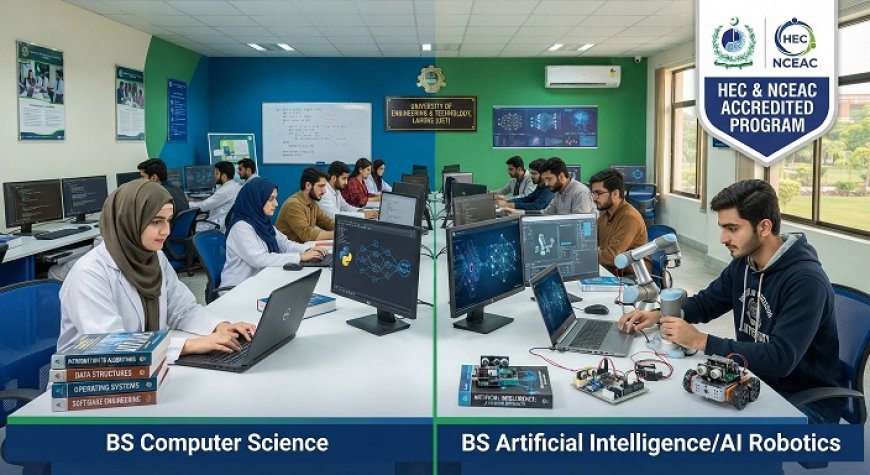
A recent circular from the National Computing Education Accreditation Council (NCEAC) has raised concerns about proposed directions for undergraduate computing programmes in Pakistan. The circular addresses two key matters: implementation of the BS Computer Science curriculum and guidance that fields like Artificial Intelligence (AI) should be offered as specialisation tracks within a single programme rather than as separate degrees.dawn
This development has sparked debate among universities and educators about whether such regulations align with global computing education trends and Pakistan's need to equip its youth with digital skills. For students planning to pursue computing degrees in 2026 and beyond, understanding these accreditation requirements is important because they can affect how universities structure and offer computing specialisations.dawn
What you will get in this guide:
-
Summary of the NCEAC circular and what it proposes for BSCS and AI programmes
-
Comparison of BS Computer Science, BS Artificial Intelligence, BS Cyber Security, and BS Data Science options in Pakistan
-
How NCEAC accreditation differs from HEC recognition
-
What Pakistani universities are currently offering in computing specialisations
-
Practical advice for students choosing computing degrees in Fall 2026 and Spring 2027
-
Answers to common questions about accreditation, specialisations, and career prospects
What Does the NCEAC Circular Say About BSCS and AI Programmes?
According to the circular discussed in Dawn (September 2, 2026), NCEAC has issued guidance on two critical issues for computing education in Pakistan.dawn
Key Directives in the Circular
1. Single Programme with Specialisation Tracks
Universities are instructed to provide a singular BS Computer Science programme and incorporate areas such as Artificial Intelligence (AI) as specialisation tracks within that programme. This means instead of offering separate BS Computer Science, BS Artificial Intelligence, BS Cyber Security, and BS Data Science degrees, universities would offer one BSCS degree with AI, Cyber Security, Data Science, and other fields as concentration areas or specialisation tracks.dawn
2. Cap on Student Enrollment
The circular also imposes restrictions on student enrollment in computing disciplines through the NCEAC Accreditation Automation System. This limits the number of students universities can admit to computing programmes based on accreditation capacity and resources.dawn
Why Is This Controversial?
Critics, including Prof (Dr) Altaf Mukati writing in Dawn, argue that this strategy does not align with the global trajectory of computing education. Key concerns include:dawn
-
AI has evolved beyond being a mere subset of Computer Science. It has transformed into a prominent academic and professional domain, encompassing rapidly growing fields like machine learning, computer vision, natural language processing, robotics, and intelligent systems.dawn
-
Restricting student enrollment in computing disciplines is concerning at a time when fields like Computer Science, Software Engineering, and AI are among the most in-demand globally and in Pakistan.dawn
-
Pakistan's demographic opportunity: With a significant portion of the population under 30, the nation has a crucial opportunity to equip its youth with valuable digital skills for careers, entrepreneurship, remote work, and export revenue.dawn
-
Comparison with neighboring countries: The disparity between Pakistan and countries like India in computing education should guide decision-making, as past restrictive decisions concerning Engineering education resulted in severe repercussions.dawn
The NCEAC is being urged to reassess its directives in collaboration with relevant stakeholders, and higher authorities are being asked to intervene to ensure policies do not limit student access to crucial academic fields.dawn
BSCS vs BS AI vs BS Cyber Security vs BS Data Science: What Are the Differences?
Students often ask whether they should choose BS Computer Science, BS Artificial Intelligence, BS Cyber Security, or BS Data Science. Understanding the differences helps you make an informed decision regardless of how NCEAC structures accreditation.
Programme Comparison Table
Which Programme Should You Choose?
Choose BS Computer Science if:
-
You want a broad, foundational degree that keeps multiple career paths open
-
You are not yet sure which specialisation (AI, Cyber Security, Data Science, etc.) you want to pursue
-
You plan to specialise later through electives, internships, or a master's degree
-
Your target university offers strong BSCS with AI/Cyber Security/Data Science electives or tracksmoawin+1
Choose BS Artificial Intelligence if:
-
You are certain you want to work in AI, machine learning, or related fields
-
The programme has a strong curriculum with hands-on ML/AI projects and industry partnerships
-
You want to differentiate yourself with a specialised AI degree from the start
-
Your target university has a reputable AI programme with good faculty and labseduhubpak+5
Choose BS Cyber Security if:
-
You are passionate about cybersecurity, ethical hacking, and protecting digital systems
-
You want to work in security operations, penetration testing, or security architecture
-
The programme offers industry certifications (CEH, CISSP, CompTIA Security+) or partnerships with cybersecurity firms
-
There is strong demand for cybersecurity professionals in your target job marketresult+3
Choose BS Data Science if:
-
You enjoy statistics, data analysis, and deriving insights from data
-
You want to work as a data scientist, data analyst, or business intelligence professional
-
The programme has strong industry connections for data science internships and projects
-
You are comfortable with mathematics, statistics, and programming in Python/Reduhubpak+3
How Does NCEAC Accreditation Differ from HEC Recognition?
It is important to understand that HEC recognition and NCEAC accreditation are different.moawin
HEC Recognition
-
What it covers: HEC recognition generally concerns the university or recognized campus as a whole.moawin
-
Why it matters: HEC recognition ensures the university meets minimum standards for higher education in Pakistan. Degrees from HEC-recognized universities are valid for government jobs, further studies, and international equivalence.
-
How to check: Visit the HEC website and search for recognized universities and campuses.
NCEAC Accreditation
-
What it covers: NCEAC accreditation relates to individual computing programmes and can be campus-specific and batch-specific.moawin
-
Why it matters: NCEAC accreditation ensures that a specific computing programme (e.g., BSCS at a particular campus for a particular admission batch) meets quality standards for computing education. This can affect programme quality, industry recognition, and sometimes eligibility for certain jobs or further studies.
-
How to check: Contact the university's computing department or check NCEAC/HEC announcements for accredited programmes.
Practical Implications for Students
-
A university may be HEC-recognized but its BSCS programme may not be NCEAC-accredited for all batches or campuses.moawin
-
Always verify both HEC recognition of the university and NCEAC accreditation status of the specific computing programme you are applying to.
-
If a programme is not yet NCEAC-accredited, ask the university about their accreditation timeline and whether current or past batches have received accreditation.
What Are Pakistani Universities Currently Offering in Computing Programmes?
Despite the NCEAC circular, many Pakistani universities continue to offer separate BS Computer Science, BS Artificial Intelligence, BS Cyber Security, and BS Data Science programmes.eduhubpak+6
Examples from Fall 2026 Admissions
University of Swabi (KPK)
-
BS Computer Science
-
BS Data Science
-
BS Software Engineering
-
BS Cyber Security
-
BS Artificial Intelligenceilmkidunya
University of Chenab (Gujrat, Punjab)
-
BS Artificial Intelligence
-
BS Data Science
-
BS Computer Science (implied through computing programmes)eduhubpak
Emerson University, Multan (Punjab)
-
BS Computer Science specializations in:
-
Artificial Intelligence
-
Computer Science
-
Cyber Security
-
Data Science
-
Information Technology
-
Software Engineeringresult
-
GCU Lahore (Punjab)
-
BS Computer Science (BSCS)
-
BS Software Engineering
-
BS Artificial Intelligence
-
BS Data Scienceilmiworld
Sir Syed University of Engineering and Technology (SSUET), Karachi (Sindh)
-
BS Computer Science (BSCS)
-
BS Software Engineering
-
BS Artificial Intelligence
-
BS Data Science
-
BS Information Technologyilmkidunya
Karachi Metropolitan University (KMU), Karachi (Sindh)
-
BSCS program with specialized streams:
-
Software Engineering
-
Artificial Intelligence
-
Cyber Security
-
Cloud Computingblog.travel-culture
-
Shaheed Benazir Bhutto University (SBBU), Shaheed Benazirabad (Sindh)
-
BS Computer Science
-
BS Artificial Intelligence
-
BS Cyber Security
-
BS Information Technologyblog.travel-culture
Quaid-i-Azam University (QAU), Islamabad
-
BS Computer Science with specialized elective focus areas including:
-
Artificial Intelligence
-
Data Science
-
Cyber Securityqau+1
-
What This Means for Students
-
Many universities are still offering separate BS AI, BS Cyber Security, and BS Data Science programmes alongside BSCS for Fall 2026 admissions.eduhubpak+6
-
The NCEAC circular may lead to changes in future admission cycles (Spring 2027 or Fall 2027), but current programmes remain available.dawn
-
Always check the latest programme offerings and accreditation status directly with universities before applying.
Should Students Worry About the NCEAC Circular When Choosing a Computing Degree?
The short answer: Be aware, but do not panic. Here is what you should consider.
Factors to Prioritise Over Accreditation Structure
1. University Reputation and Faculty Quality
A strong BSCS programme with excellent faculty, labs, and industry connections may be more valuable than a specialised BS AI degree from a weaker university.moawin
2. Curriculum and Electives
Check the actual courses offered. A BSCS programme with AI, Cyber Security, and Data Science electives can give you similar skills to a specialised BS AI degree.moawin+1
3. Industry Partnerships and Internships
Universities with strong industry ties offer better internship and placement opportunities, regardless of whether the degree is BSCS or BS AI.moawin+1
4. Accreditation Status
Verify both HEC recognition and NCEAC accreditation for the specific programme and campus you are applying to.moawin
5. Your Career Goals
If you are certain about AI, a BS AI degree from a reputable university may give you a head start. If you are unsure, BSCS offers more flexibility.moawin
What Could Change in the Future?
If NCEAC implements its circular strictly:
-
Universities may merge separate BS AI, BS Cyber Security, and BS Data Science programmes into a single BSCS degree with specialisation tracks.dawn
-
Your degree certificate may show BS Computer Science with a mention of your specialisation (e.g., "BS Computer Science with specialisation in Artificial Intelligence").
-
The core curriculum would be standardised across BSCS programmes, with specialisation courses in later semesters.
This is similar to how some international universities structure computing degrees: a common BSCS core with concentration areas in AI, Cyber Security, Data Science, Software Engineering, etc.excelsior+1
What Should You Do Now?
For Fall 2026 and Spring 2027 applicants:
-
Apply to programmes that match your interests (BSCS, BS AI, BS Cyber Security, BS Data Science) as they are currently offered.eduhubpak+6
-
Verify accreditation status with each university before applying.
-
Do not delay your admission waiting for NCEAC policy clarity; the circular's implementation timeline is not yet clear.dawn
For future applicants (Fall 2027 and beyond):
-
Monitor NCEAC and HEC announcements for updates on computing programme accreditation.
-
Be prepared for possible restructuring of computing degrees into a single BSCS with specialisation tracks.
-
Focus on universities with strong faculty, labs, and industry connections regardless of programme structure.
Myth vs Fact: NCEAC and Computing Degrees in Pakistan
E-E-A-T Reinforcement: Why Trust This Information?
This article is based on official and credible sources about computing education in Pakistan.
Sources used:
-
Dawn newspaper opinion article (September 2, 2026) discussing the NCEAC circulardawn
-
HEC-NCEAC expert review team reports and NSCT 2026 benchmarking exerciseslinkedin
-
Official university admission pages for Fall 2026 (University of Swabi, University of Chenab, Emerson University Multan, GCU Lahore, SSUET Karachi, Karachi Metropolitan University, Shaheed Benazir Bhutto University, Quaid-i-Azam University)qau+8
-
HEC and NCEAC accreditation guidance documentsmoawin
Editorial judgment:
-
The NCEAC circular's implications are explained based on the Dawn article and broader computing education trends in Pakistandawn
-
Programme comparisons are based on standard computing curricula and career pathways recognized by HEC and international computing education bodiesmoawin
-
University programme offerings are verified from official admission pages for Fall 2026
Last checked: September 3, 2026, 1:00 PM PKT
Reminder: The NCEAC circular is still under discussion, and implementation details may change. Always verify programme structure, accreditation status, and admission requirements directly with universities and official NCEAC/HEC notices before making admission decisions.dawn+1
FAQ Section
What is the NCEAC circular about BS Computer Science and AI in Pakistan?
The NCEAC circular addresses two critical issues: implementation of the BS Computer Science curriculum and guidance that universities should provide a singular BSCS programme with fields like Artificial Intelligence (AI) as specialisation tracks rather than separate degrees. The circular has raised concerns among educators about alignment with global computing education trends.dawn
Is BS Artificial Intelligence better than BS Computer Science in Pakistan?
Neither is inherently better; it depends on your goals. BS Computer Science offers a broad foundation with flexibility to specialise later, while BS Artificial Intelligence provides focused training in AI/ML from the start. If you are certain about AI careers, BS AI may be advantageous. If you want flexibility, BSCS is a strong choice.moawin
Are Pakistani universities still offering separate BS AI, BS Cyber Security and BS Data Science programmes?
Yes, many Pakistani universities are still offering separate BS Artificial Intelligence, BS Cyber Security, and BS Data Science programmes alongside BS Computer Science for Fall 2026 admissions. Examples include University of Swabi, GCU Lahore, SSUET Karachi, Emerson University Multan, and Karachi Metropolitan University.eduhubpak+6
What is the difference between HEC recognition and NCEAC accreditation?
HEC recognition concerns the university or recognized campus as a whole, while NCEAC accreditation relates to individual computing programmes and can be campus-specific and batch-specific. Both are important: HEC recognition ensures degree validity, while NCEAC accreditation ensures programme quality.moawin
Will the NCEAC circular affect students already enrolled in BS AI or BS Cyber Security programmes?
The circular's implementation timeline and impact on current students are not yet clear. Typically, accreditation changes affect future admission cycles rather than currently enrolled students. Contact your university's computing department for specific guidance.dawn
Should I wait for NCEAC policy clarity before applying for computing programmes in 2026?
No, you should not delay your admission waiting for NCEAC policy clarity. Many universities are still offering separate BS AI, BS Cyber Security, and BS Data Science programmes for Fall 2026 and Spring 2027. Apply to programmes that match your interests and verify accreditation status with each university.dawn
What careers can I pursue with a BS Computer Science degree in Pakistan?
BS Computer Science graduates can work as Software Developers, Systems Engineers, Full-Stack Developers, DevOps Engineers, IT Consultants, and Researchers. The broad foundation also allows specialisation in AI, Cyber Security, Data Science, or other fields through electives, internships, or master's studies.moawin
What careers can I pursue with a BS Artificial Intelligence degree in Pakistan?
BS Artificial Intelligence graduates can work as AI Engineers, Machine Learning Engineers, Data Scientists, AI Researchers, Robotics Engineers, and NLP Specialists. AI is a rapidly growing field with strong demand in Pakistan and internationally.moawin
Is NCEAC accreditation mandatory for computing programmes in Pakistan?
NCEAC accreditation is not strictly mandatory for programme operation, but it ensures quality standards and can affect industry recognition and eligibility for certain jobs or further studies. Always verify both HEC recognition and NCEAC accreditation status before applying.moawin
How can I check if a computing programme is NCEAC-accredited?
Contact the university's computing department or admissions office directly to ask about NCEAC accreditation status for the specific programme and campus. You can also check HEC and NCEAC announcements for accredited programmes and batches.moawin
What if my university merges BS AI into BSCS as a specialisation track?
If universities merge BS AI into BSCS as a specialisation track, your degree certificate may show "BS Computer Science with specialisation in Artificial Intelligence." The core curriculum would be standardised, with AI courses in later semesters. This is similar to international computing degree structures.excelsior+2
Does the NCEAC circular cap the number of students in computing programmes?
Yes, the circular imposes restrictions on student enrollment in computing disciplines through the NCEAC Accreditation Automation System. This limits the number of students universities can admit to computing programmes based on accreditation capacity and resources.dawn
Are there job opportunities for BS Cyber Security and BS Data Science graduates in Pakistan?
Yes, there is strong demand for BS Cyber Security graduates (Security Analysts, Penetration Testers, Security Engineers) and BS Data Science graduates (Data Scientists, Data Analysts, Business Intelligence Analysts) in Pakistan and internationally. Cybersecurity and data analytics are among the fastest-growing fields globally.moawin
Which Pakistani universities are known for strong computing programmes?
Top universities for computing in Pakistan include FAST NUCES, NUST, COMSATS, GIKI, ITU, LUMS, Quaid-i-Azam University, GCU Lahore, and University of Engineering and Technology (UET) campuses. Also check emerging universities with strong faculty, labs, and industry partnerships in your region.moawin
What should I prioritise when choosing a computing programme in Pakistan?
Prioritise: (1) university reputation and faculty quality, (2) curriculum and electives offered, (3) industry partnerships and internship opportunities, (4) HEC recognition and NCEAC accreditation status, and (5) alignment with your career goals. Programme structure (BSCS vs BS AI) is less important than overall programme quality.moawin+1
Conclusion
The NCEAC circular on BS Computer Science and AI specialisations has sparked important debate about computing education in Pakistan. While the circular proposes offering AI and other fields as specialisation tracks within a single BSCS programme, many universities continue to offer separate BS AI, BS Cyber Security, and BS Data Science degrees for Fall 2026 admissions.dawn+7
Next steps for students:
-
Identify your career interests: Are you drawn to AI/ML, cybersecurity, data science, or general software development?
-
Research universities: Compare BSCS, BS AI, BS Cyber Security, and BS Data Science programmes at HEC-recognized universities with strong faculty and industry connections.moawin
-
Verify accreditation: Check both HEC recognition and NCEAC accreditation status for the specific programme and campus.moawin
-
Apply early: Do not delay your admission waiting for NCEAC policy clarity; current programmes remain available for Fall 2026 and Spring 2027.dawn
-
Monitor updates: Keep an eye on NCEAC and HEC announcements for any changes to computing programme accreditation in future admission cycles.
What's Your Reaction?
 Like
0
Like
0
 Dislike
0
Dislike
0
 Love
0
Love
0
 Funny
0
Funny
0
 Angry
0
Angry
0
 Sad
0
Sad
0
 Wow
0
Wow
0