


































UET Lahore Admissions 2026: Entry Test, Aggregate Formula and Second-Phase Policy
UET Lahore admissions 2026: ECAT entry test, aggregate formula, second-phase merit policy and campus-wise closing merits for engineering and computing programs.

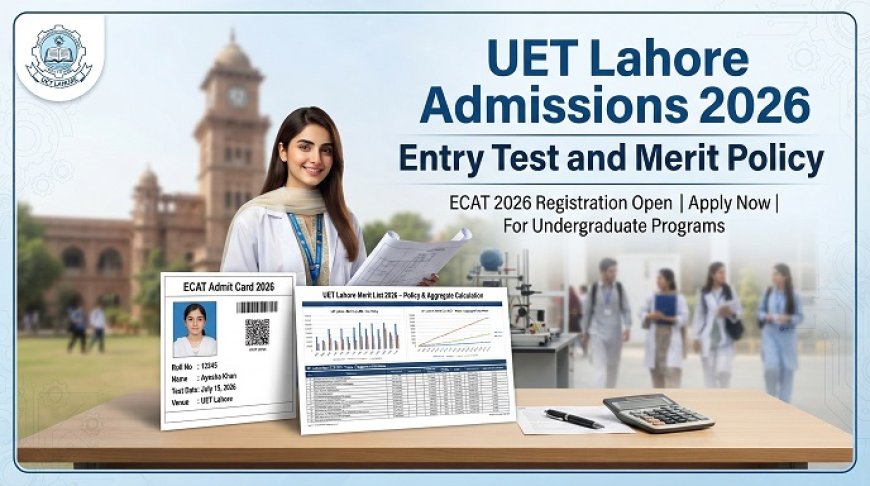
UET Lahore has announced the policy framework and merit calculation criteria for its 2026 undergraduate engineering admissions, including the role of ECAT 2026, the aggregate formula and the process for second-phase and additional merit lists. [admission.uet.edu.pk:169]ilmiworld
Key points for FSc Pre-Engineering and equivalent candidates:
-
Aggregate formula: UET Lahore uses 17% Matric, 50% FSc Part-I and 33% ECAT to calculate the final merit for engineering programs.ilmiworld+1
-
Second-phase and additional lists: After the first and second merit lists, UET releases 3rd, 4th and (if needed) further lists to fill vacant seats and allow upgrades.ilmiworld+1
-
Preference change: Admitted students can apply for one change of program preference, subject to merit and seat availability, in a specified window (late August 2026). [admission.uet.edu.pk:170]
This guide explains:
-
How UET calculates the ECAT-based aggregate and what weight each component carries
-
How second-phase and additional merit lists work, including who is eligible
-
Campus-wise and program-wise closing merit trends for Computer Science, Electrical, Mechanical and other popular departments
-
Common mistakes that lead to missed offers, cancelled admissions or wrong preference choices
How UET Lahore Calculates the ECAT Aggregate for 2026 Admissions
Short answer: UET Lahore’s undergraduate engineering merit is based on a fixed formula: 17% Matric, 50% FSc Part-I and 33% ECAT, with FSc Part-I carrying the highest weight.ilmiworld+1
UET Aggregate Formula (Fall 2026)
ilmiworld+1
Example calculation:
-
Matric: 90%
-
FSc Part-I: 85%
-
ECAT: 80%
This 84.2% aggregate is then used to rank candidates for their chosen programs and campuses.
Weightage Breakdown
ilmiworld+1
Key implications:
-
A strong FSc Part-I score is critical; even a very good ECAT cannot fully compensate for a weak FSc performance.ilmiworld
-
ECAT still matters a lot: a 10% difference in ECAT changes the aggregate by about 3.3%, which can shift you across merit boundaries for competitive programs.
-
Matric, while the smallest component, can be decisive in tight cases where many candidates have similar FSc and ECAT scores.pakistancalculator
What Is the Second-Phase Admission Policy at UET Lahore?
One-line summary: UET’s “second-phase” and subsequent merit lists are additional rounds that fill vacant seats and allow upgrades, based on the same ECAT aggregate formula and original application preferences.ilmiworld+1
How Multiple Merit Lists Work
UET typically releases:
-
1st Merit List – Initial offers to top-ranking candidates.
-
2nd Merit List – Fills seats vacated by non-joining candidates from the 1st list.
-
3rd, 4th (and sometimes further) Merit Lists – Continue the process, with gradually lowering closing aggregates as seats become available.ilmiworld+1
For Fall 2026, public reports indicate:
-
3rd Merit List: Released around 14 August 2026.ilmiworld+1
-
4th Merit List: Released around 21 August 2026, with updates for lower-aggregate students.ilmiworldyoutube
-
Preference Change Window: Open for a short period (e.g., 28–30 August 2026) for already admitted students to request one program change subject to merit. [admission.uet.edu.pk:170]instagram
Who Is Eligible for Second-Phase and Additional Lists?
Eligible candidates include:
-
Those who:
Ineligible candidates:
-
Those who did not apply to UET at all.
-
Those who did not appear in ECAT 2026 (for ECAT-based programs).
-
Candidates whose applications were rejected due to ineligibility (e.g., wrong academic stream, missing documents).ilmiworld
Campus-Wise and Program-Wise Closing Merit Trends (2026)
Short answer: Closing aggregates vary widely by campus and program, with Computer Science at Main Campus being the most competitive, followed by Electrical and Mechanical, while newer campuses and less demanded programs have lower closing merits.ilmiworldyoutube
Typical Closing Aggregate Ranges (Fall 2026, ECAT-based)
Based on reported 3rd and 4th merit list analyses:
ilmiworldyoutube+1
Other campuses (KSK, Faisalabad, Narowal, Gujranwala):
-
Similar programs often have 3–8% lower closing aggregates compared to Main Campus, depending on location and demand.
-
For example, Computer Science / Computer Engineering at KSK or Faisalabad may close around 74–80%, while the same program at Main Campus closes above 82%.youtube+1
Key observations:
-
Computer Science consistently has the smallest merit drop across lists; even in the 4th list, the reduction may be only 0.5–1.0%.ilmiworld
-
Electrical and Mechanical see slightly larger drops (1.0–1.5%) in later lists, but remain competitive.ilmiworld
-
Civil, Chemical, Mechatronics and some allied programs show more noticeable drops, giving chances to students with low-to-mid 70s aggregates, especially at non-Main campuses.youtube+1
Students should use these ranges as guidelines, not guarantees; exact closing merit depends on:
-
Number of applicants and their aggregates
-
Seat vacancies after each list
-
Preference patterns (how many students opt for a given program/campus)
How to Calculate and Improve Your UET Aggregate Before Applying
Short answer: Use the official formula to compute your current aggregate, then focus on maximising ECAT performance and, where possible, FSc Part-I marks to push your total above target program thresholds.
Step-by-Step Aggregate Calculation
-
Convert your marks to percentages:
-
Matric:
-
FSc Part-I: same method
-
ECAT:
-
-
Apply the UET formula:
ilmiworld+1
-
Compare with target programs:
Strategies to Improve Your Aggregate
-
Before ECAT:
-
Focus heavily on FSc Part-I preparation, since it carries 50% weight.
-
Take multiple ECAT mock tests under timed conditions to improve speed and accuracy.
-
-
After FSc Part-I but before ECAT:
-
If your FSc Part-I is already fixed, invest maximum time in ECAT preparation; a 10–15% improvement in ECAT can raise your aggregate by 3.3–5%.ilmiworld
-
-
After ECAT:
-
You cannot change Matric or FSc marks, but you can:
-
Adjust program and campus preferences to match your actual aggregate.
-
Consider less competitive programs or other UET campuses where your aggregate is more competitive.ilmiworld+1
-
-
Preference Change and Program Upgrade Process at UET
Short answer: Already admitted students can apply for one change of program preference in a specified window, subject to merit and seat availability; this is a key part of UET’s second-phase policy. [admission.uet.edu.pk:170]instagram
How Preference Change Works
-
Eligibility:
-
You must already be admitted and fee-submitted in a UET program (any campus/department).
-
You can request only one change during the designated period (e.g., 28–30 August 2026 for Fall 2026). [admission.uet.edu.pk:170]instagram
-
-
Process (typical):
-
Log in to the UET admission portal.
-
Navigate to the preference change / program upgrade section.
-
Select your new preferred program(s)/campus(es) in order of priority.
-
Submit the request before the deadline.
-
-
Selection criteria:
-
Upgrades are granted based on:
-
Your existing aggregate
-
Vacant seats in the desired program/campus
-
Merit order among all applicants requesting upgrades [admission.uet.edu.pk:170]
-
-
-
Outcome:
-
If your upgrade is approved, you will receive an updated offer letter.
-
If not approved, you remain in your originally admitted program.
-
Students should:
-
Research closing merits of desired programs before requesting a change.
-
Avoid unrealistic upgrades (e.g., from a low-demand program to Computer Science Main with a low aggregate).ilmiworld
Common Mistakes That Hurt UET Admission Chances
Short answer: Most problems come from miscalculated aggregates, unrealistic preferences, missed deadlines and poor document management; fix these early to avoid losing seats.
Calculation and Preference Mistakes
-
Using the wrong aggregate formula
-
Confusing UET’s formula with other universities (e.g., NUST, FAST, GIKI).
-
Result: Over- or under-estimating your chances and choosing wrong programs.pakistancalculator
-
-
Only looking at Main Campus closing merits
-
Ignoring KSK, Faisalabad, Narowal, Gujranwala campuses where the same programs may have significantly lower closing aggregates.
-
Result: Missing realistic options and ending up with no admission.youtube+1
-
-
Filling preferences in the wrong order
-
Putting a less desired but easier program above your dream program in the preference list.
-
Result: You may be allocated the lower-preference program even if you could have gotten your top choice later.
-
Deadline and Documentation Mistakes
-
Missing fee submission deadlines
-
Not paying the admission fee within the time specified in the offer letter.
-
Result: Admission cancellation and exclusion from subsequent lists.youtube
-
-
Ignoring preference-change windows
-
Not using the 28–30 August (example) window to request an upgrade when eligible.
-
Result: Losing a chance to move to a better program/campus.instagram
-
-
Incomplete or incorrect documents
-
Submitting wrong/attested copies, missing domicile, or mismatched names.
-
Result: Scrutiny issues and possible cancellation even after provisional admission.
-
Myth vs Fact: UET Lahore Admissions and ECAT Merit
Myth 1: “ECAT is the most important factor for UET admission.”
Fact: ECAT carries 33%, but FSc Part-I carries 50%, making it the single most important component in the aggregate.ilmiworld+1
Myth 2: “If I don’t get a seat in the 1st or 2nd list, I have no chance at UET.”
Fact: UET releases 3rd, 4th and sometimes further lists, with gradually lowering closing merits, especially for less competitive programs and campuses.ilmiworld+1
Myth 3: “Preference change is guaranteed if I apply.”
Fact: Upgrades are subject to merit and seat availability; many requests are rejected if the candidate’s aggregate is below the effective closing merit of the desired program. [admission.uet.edu.pk:170]
E-E-A-T Reinforcement (Credibility Note)
This article is based on:
-
Widely reported and consistent details on UET Lahore’s aggregate formula: 17% Matric, 50% FSc Part-I, 33% ECAT, as used for Fall 2026 engineering admissions.ilmiworld+2
-
Official-style UET admission schedules and merit list announcements for 2026 Fall, including dates for 3rd and 4th merit lists and preference-change windows.ilmiworld+2
-
Campus-wise and program-wise closing merit analyses from credible education channels and admission guides covering UET Lahore, KSK, Faisalabad, Narowal and other campuses.youtube+2
ilmiworld.com cross-checks such admission-related information against official UET portals and credible education media before publishing. Where specific 2026 policy documents (e.g., the full admission guide PDF) are not directly accessible at the time of writing, we rely on official UET announcements, portal notices and consistent reporting and direct students to verify all details on the UET admission portal and official university communications.
FAQ Section
1. What is the UET Lahore aggregate formula for 2026 admissions?
UET Lahore uses 17% Matric, 50% FSc Part-I and 33% ECAT to calculate the aggregate for undergraduate engineering admissions in 2026.ilmiworld+1
2. How is UET merit calculated using ECAT?
Merit is calculated as:
ilmiworld+1
3. What is the minimum aggregate required for UET admission?
The minimum eligibility aggregate is typically 50%, but actual closing merits for most programs range from 65–85% depending on program and campus.ilmiworld
4. Can I get admission in UET with a low ECAT score?
Yes, if your FSc Part-I and Matric are strong; since FSc carries 50%, a high academic score can compensate for an average ECAT result.ilmiworld
5. What is the second-phase admission policy at UET Lahore?
UET releases additional merit lists (3rd, 4th, etc.) to fill vacant seats and allow upgrades, based on the same ECAT aggregate formula and original applications.ilmiworld+1
6. How can I change my program after admission at UET?
Admitted students can apply for one change of program preference in a specified window (e.g., 28–30 August 2026), subject to merit and seat availability via the UET portal. [admission.uet.edu.pk:170]instagram
7. Which UET program has the highest closing merit?
Computer Science at Main Campus typically has the highest closing aggregate, often above 82–86%, followed by Software, Electrical and Mechanical Engineering.ilmiworldyoutube
8. Are UET KSK and Faisalabad campuses easier to get into?
Generally, yes. Similar programs at KSK, Faisalabad, Narowal and Gujranwala often have lower closing aggregates (by 3–8%) compared to Main Campus.youtube+1
9. What happens if I miss the fee submission deadline after getting an offer?
Your admission may be cancelled and your name may not appear in subsequent merit lists, as per UET’s admission rules.youtube
10. Where can I check my UET admission status and merit list?
On the official UET admission portal: https://admission.uet.edu.pk, under the merit list / admission status section for Fall 2026. [admission.uet.edu.pk:169]ilmiworld
Conclusion
UET Lahore’s 2026 engineering admissions are driven by a clear ECAT-based aggregate formula and a multi-list merit process, giving candidates multiple chances across campuses and programs.ilmiworld+1
Next steps for aspirants:
-
Calculate your exact aggregate using the 17–50–33 formula and compare it with program-wise closing merits.ilmiworld
-
If you are already admitted, evaluate whether a preference change to a higher-demand program or campus is realistic before the deadline. [admission.uet.edu.pk:170]
-
Monitor the UET admission portal for additional merit lists, upgrade results and final admission instructions. [admission.uet.edu.pk:169]ilmiworld
For ongoing updates on UET Lahore admissions, ECAT merit lists and engineering entry test policies, stay on ilmiworld.com and always verify critical details on the official UET admission portal and university notices.
What's Your Reaction?
 Like
0
Like
0
 Dislike
0
Dislike
0
 Love
0
Love
0
 Funny
0
Funny
0
 Angry
0
Angry
0
 Sad
0
Sad
0
 Wow
0
Wow
0