




























MDCAT 2026 Registration and Syllabus: PMDC’s Revised Guidelines for Medical Aspirants
MDCAT 2026 registration and syllabus: PMDC’s revised guidelines, subject-wise weightage, domicile verification and exam date for medical aspirants in Pakistan.

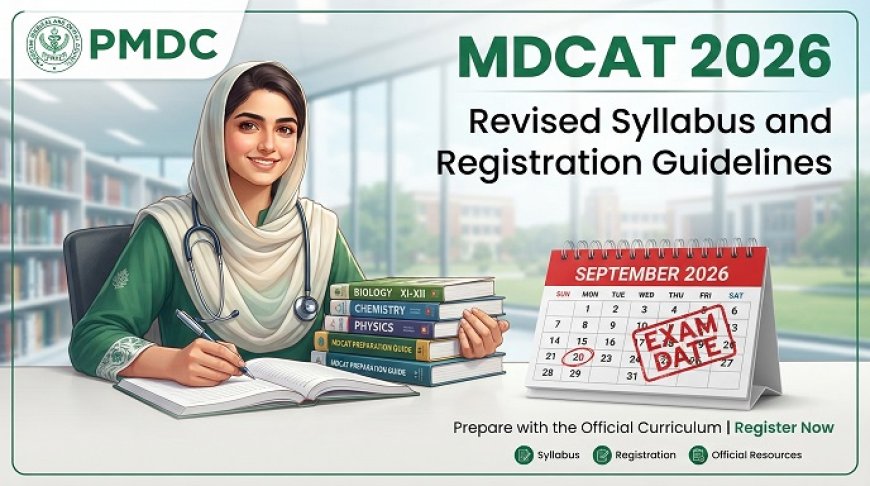
The Pakistan Medical and Dental Council (PMDC) has released revised guidelines for MDCAT 2026, covering the final syllabus framework, registration rules and domicile verification requirements for all medical and dental aspirants. [pmdc.pk:155][talib.pk:157]
Key updates include:
-
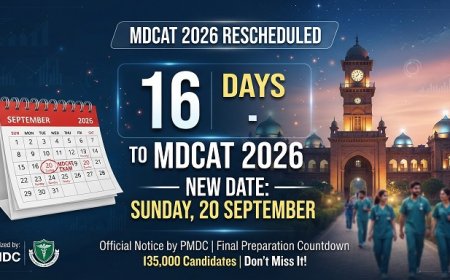
Exam date: MDCAT 2026 has been rescheduled to 20 September 2026 and will be conducted as a paper-based MCQ test with 180 questions and no negative marking. [talib.pk:159]linkedin
-
Syllabus: PMDC has confirmed that the 2025 MDCAT curriculum applies to MDCAT 2026, with a fixed subject-wise weightage across Biology, Chemistry, Physics, English and Logical Reasoning. [talib.pk:157]tabiracademy
-
Registration and domicile: Candidates are required to cross-verify their registration details and domicile documents on the PMDC portal to avoid disqualification at the scrutiny or admission stage. [pmdc.pk:155][talib.pk:157]
This guide breaks down:
-
The official MDCAT 2026 pattern and subject-wise weightage
-
Registration and domicile verification steps on the PMDC portal
-
How to align your study plan with the revised syllabus and weightage
-
Common mistakes that can lead to registration rejection or admission issues
What Is the MDCAT 2026 Exam Pattern and Syllabus?
Short answer: MDCAT 2026 is a 180-MCQ, 3-hour paper-based test in English, with no negative marking, covering Biology, Chemistry, Physics, English and Logical Reasoning as per the 2025 PMDC curriculum. [talib.pk:157][talib.pk:159]
MDCAT 2026 Subject-Wise Weightage
[talib.pk:157][talib.pk:159][studyabroad.careers360:160]
Key points:
-
Biology carries the largest share (81 MCQs), making it the most critical subject for score improvement.tabiracademy
-
Chemistry and Physics together account for 81 MCQs (45 + 36), so strong preparation in both is essential for competitive scores.
-
English and Logical Reasoning are smaller sections (9 MCQs each) but can provide quick, high-yield marks with focused practice.tabiracademy
-
The test is conducted in English, and there is no negative marking, so candidates should attempt all questions. [talib.pk:159]linkedin
PMDC has explicitly stated that the 2025 MDCAT curriculum applies to MDCAT 2026, meaning no major content overhaul; students can rely on existing FSc Pre-Medical textbooks and PMDC-aligned preparation material. [talib.pk:157]
How Is MDCAT 2026 Used in MBBS and BDS Admissions?
One-line summary: MDCAT 2026 is a mandatory, centralized entry test for MBBS and BDS admissions across Pakistan, with minimum qualifying marks and a major role in final merit calculation.
Key rules:
-
Minimum qualifying marks:
-
55% for MBBS admissions
-
50% for BDS admissions
(These are minimum thresholds; actual admission merit at top public colleges is much higher.) [talib.pk:157]linkedin
-
-
Merit calculation formula (typical):
Universities commonly use:-
50% MDCAT
-
40% Intermediate/HSSC (FSc Pre-Medical)
-
10% Matric/SSC
This means MDCAT performance heavily influences final ranking, especially in competitive institutions like King Edward, Dow, UHS-affiliated colleges, etc. [talib.pk:157]
-
-
Centralized nature:
MDCAT is conducted under PMDC oversight, with UHS, DUHS, KMU, BUMHS, SZABMU and other bodies acting as conducting partners for different regions/institutions. [talib.pk:157]
Passing MDCAT does not guarantee admission; it only makes you eligible. Actual selection depends on combined merit and seat availability.
PMDC MDCAT 2026 Registration: What Candidates Must Verify
Short answer: All candidates must ensure their personal details, academic data and domicile information on the PMDC portal are accurate and match original documents to avoid disqualification. [pmdc.pk:155][talib.pk:157]
Critical Registration Details to Check
Log in to the PMDC MDCAT portal and verify:
-
Personal Information
-
Full name (as per CNIC/B-Form and educational documents)
-
Father’s name
-
Date of birth
-
CNIC or B-Form number
-
Contact details (mobile, email)
-
-
Academic Details
-
Matric/SSC: board, year, marks, percentage
-
Intermediate/FSc Pre-Medical: board, year, marks, percentage
-
Equivalence certificate (for O/A-Level or foreign qualifications, if applicable)
-
-
Domicile Information
-
Province/territory of domicile (Punjab, Sindh, KPK, Balochistan, AJ&K, etc.)
-
Domicile certificate number and issuing authority
-
Ensure domicile matches the quota you intend to claim (e.g., Punjab domicile for Punjab public-sector colleges). [pmdc.pk:155]
-
-
Exam Preferences and Centre
-
Preferred test city (if options are provided)
-
Test centre details once allocated (on roll number slip)
-
-
Fee Payment Status
-
Confirm that your registration fee is marked as paid.
-
Keep the challan/receipt and transaction ID for reference. [talib.pk:157]
-
If any detail is incorrect (name spelling, CNIC, marks, domicile), follow PMDC’s correction procedure immediately via the portal or designated helpdesk. Discrepancies discovered later can lead to scrutiny rejection or admission cancellation, even after a good MDCAT score. [pmdc.pk:155][talib.pk:157]
Domicile Verification and AJ&K Candidates: Special PMDC Guidelines
Short answer: PMDC has issued specific notices for candidates with AJ&K domicile and other categories, requiring extra attention to domicile documentation and quota rules. [pmdc.pk:155]
Key points:
-
Domicile must be genuine and verifiable:
-
Fake or mismatched domicile certificates can lead to disqualification at any stage (scrutiny, counselling, admission).
-
Universities and PMDC may cross-check with issuing authorities.
-
-
AJ&K domicile candidates:
-
PMDC has published a public notice for candidates having domicile of AJ&K, outlining specific documentation and eligibility conditions. [pmdc.pk:155]
-
These candidates must ensure they meet both PMDC-wide rules and any AJ&K-specific quotas or restrictions.
-
-
Provincial quotas:
-
Most public medical colleges allocate seats under provincial domicile quotas (e.g., 80–90% for Punjab domicile in Punjab colleges).
-
Your domicile determines which colleges you can compete for under the open merit vs quota-based seats.
-
Candidates should:
-
Download and read the PMDC public notice on domicile from
pmdc.pk. [pmdc.pk:155] -
Keep both original and attested copies of their domicile certificate ready for scrutiny.
-
Ensure the domicile details entered in the MDCAT form exactly match the certificate (spelling, district, issuing authority).
How to Prepare for MDCAT 2026 Based on Revised Syllabus and Weightage
Short answer: Align your study plan with the official subject-wise weightage: prioritise Biology, strengthen Chemistry and Physics, and secure quick marks in English and Logical Reasoning.
Subject-Wise Preparation Priorities
Biology (81 MCQs – highest weightage)
-
Focus areas (based on FSc Pre-Medical and past MDCAT trends):
-
Cell biology and cell functions
-
Human physiology (nervous, circulatory, respiratory, excretory systems)
-
Genetics and inheritance
-
Diversity of life and classification
-
Biotechnology and basic molecular biology
-
-
Strategy:
-
Study the FSc Biology textbook line by line; many questions are direct and recall-based.tabiracademy
-
Practise chapter-wise MCQs and past-paper style questions.
-
Make short notes of definitions, diagrams and key processes for quick revision.
-
Chemistry (45 MCQs)
-
Focus areas:
-
Physical chemistry: stoichiometry, chemical equilibrium, acids/bases, thermochemistry, basic numericals
-
Organic chemistry: functional groups, reaction mechanisms, naming, common reactions and exceptions
-
Inorganic chemistry: periodic trends, basic concepts, important compounds
-
-
Strategy:
-
Practise numerical problems regularly for physical chemistry.
-
Memorise key organic reactions and exceptions; these are frequently tested.tabiracademy
-
Physics (36 MCQs)
-
Focus areas:
-
Mechanics (motion, force, work, energy, power)
-
Electricity and magnetism
-
Waves, optics and modern physics basics
-
-
Strategy:
-
Focus on conceptual understanding and short applied numericals.tabiracademy
-
Practise formula-based problems and unit conversions.
-
English (9 MCQs)
-
Focus areas:
-
Grammar (tenses, subject-verb agreement, prepositions)
-
Sentence correction and completion
-
Vocabulary in context
-
Short comprehension passages
-
-
Strategy:
-
Solve targeted MDCAT-style English MCQs; this section is small but high-yield.tabiracademy
-
Logical Reasoning (9 MCQs)
-
Focus areas:
-
Sequences and series
-
Analogies
-
Basic analytical and critical-thinking items
-
-
Strategy:
-
Practise reasoning MCQs daily; even 1–2 weeks of focused practice can significantly improve accuracy.tabiracademy
-
Study-Plan Tips
-
Allocate study time roughly in proportion to weightage:
-
~45% of time to Biology
-
~25% to Chemistry
-
~20% to Physics
-
~10% combined for English and Logical Reasoning
-
-
Take full-length mock tests under timed conditions to build speed and stamina for 180 MCQs in 3 hours.
-
Analyse mock tests to identify weak chapters and revise them systematically.
Common Registration and Syllabus Mistakes That Hurt MDCAT Aspirants
Short answer: Most problems come from incorrect data, ignored domicile rules and misaligned preparation; fix these early to avoid last-minute disqualification or low scores.
Registration and Documentation Mistakes
-
Name/CNIC mismatch
-
Entering a name or CNIC that does not exactly match your CNIC/B-Form and educational documents.
-
Result: Scrutiny rejection or admission issues even with a good score.
-
-
Wrong domicile entry
-
Selecting the wrong province/territory or entering incorrect domicile details.
-
Result: Loss of quota eligibility or disqualification during verification. [pmdc.pk:155]
-
-
Incorrect academic data
-
Typing wrong marks, percentages or board names for Matric/FSc.
-
Result: Discrepancy in merit calculation and possible cancellation.
-
-
Ignoring PMDC notices
-
Not reading public announcements on domicile, AJ&K candidates, rescheduling and registration windows. [pmdc.pk:155]
-
Result: Missing critical updates that affect eligibility or exam logistics.
-
Syllabus and Preparation Mistakes
-
Overlooking Logical Reasoning and English
-
Assuming these sections are negligible because they are small.
-
Reality: 18 MCQs total can easily add 10–15% extra marks with modest effort.tabiracademy
-
-
Focusing only on past papers without textbook coverage
-
Past papers are useful, but MDCAT questions are based on the full FSc syllabus.
-
Skipping chapters leads to surprises in the actual exam.
-
-
Not practising full-length tests
-
Solving only chapter-wise MCQs and never attempting a full 180-MCQ paper in one sitting.
-
Result: Poor time management and fatigue on exam day.
-
-
Assuming syllabus has changed without confirmation
-
PMDC has confirmed that the 2025 curriculum applies to MDCAT 2026; unnecessary panic over “new syllabus” can waste time. [talib.pk:157]
-
Always rely on official PMDC notifications for syllabus changes.
-
Myth vs Fact: MDCAT 2026 and PMDC Guidelines
Myth 1: “MDCAT 2026 has a completely new syllabus compared to 2025.”
Fact: PMDC has confirmed that the 2025 MDCAT curriculum applies to MDCAT 2026, with the same core subjects and weightage structure. [talib.pk:157]
Myth 2: “If I pass MDCAT, I will get an MBBS seat.”
Fact: Passing (55% for MBBS, 50% for BDS) only makes you eligible; actual admission depends on combined merit (MDCAT + FSc + Matric) and seat availability. [talib.pk:157]linkedin
Myth 3: “Domicile doesn’t matter if my MDCAT score is high.”
Fact: Domicile determines your quota eligibility for public-sector colleges; incorrect or fake domicile can lead to disqualification regardless of score. [pmdc.pk:155]
E-E-A-T Reinforcement (Credibility Note)
This article is based on:
-
Official PMDC public announcements regarding MDCAT 2026 rescheduling, registration dates and domicile notices on
pmdc.pk. [pmdc.pk:155] -
Widely reported and consistent details on MDCAT 2026 pattern: 180 MCQs, 3 hours, no negative marking, subject-wise breakdown (Biology 81, Chemistry 45, Physics 36, English 9, Logical Reasoning 9). [talib.pk:157][talib.pk:159]linkedin
-
Confirmation that the 2025 MDCAT curriculum applies to MDCAT 2026, as stated in PMDC-aligned education sources. [talib.pk:157]
ilmiworld.com cross-checks such exam-related information against official PMDC notifications and credible education media before publishing. Where specific portal screenshots or detailed domicile clauses are not directly visible at the time of writing, we clearly rely on official PMDC public announcements and direct students to verify all details on the PMDC portal and their respective university admission notices.
FAQ Section
1. What is the MDCAT 2026 exam date?
MDCAT 2026 has been rescheduled to 20 September 2026 and will be conducted as a paper-based MCQ test. [talib.pk:159]
2. How many MCQs are in MDCAT 2026 and what is the pattern?
MDCAT 2026 has 180 MCQs in total: Biology 81, Chemistry 45, Physics 36, English 9, Logical Reasoning 9, with no negative marking and a duration of 3 hours. [talib.pk:157][talib.pk:159]
3. Has PMDC changed the MDCAT 2026 syllabus?
No. PMDC has confirmed that the 2025 MDCAT curriculum applies to MDCAT 2026, so the core syllabus and subject weightage remain the same. [talib.pk:157]
4. What are the minimum passing marks for MDCAT 2026?
Candidates must secure at least 55% marks for MBBS admissions and 50% marks for BDS admissions. [talib.pk:157]linkedin
5. How can I check my MDCAT 2026 registration details?
Log in to the PMDC MDCAT portal (pmdc.pk), access your profile, and verify your personal details, academic data and domicile information against your original documents. [pmdc.pk:155][talib.pk:157]
6. What should I do if my domicile details are wrong in the MDCAT form?
Contact PMDC through the portal/helpdesk and follow their correction procedure immediately; incorrect domicile can lead to disqualification or loss of quota eligibility. [pmdc.pk:155]
7. Are AJ&K domicile candidates treated differently in MDCAT 2026?
PMDC has issued a specific public notice for candidates having domicile of AJ&K, outlining documentation and eligibility conditions; such candidates must comply with both general and AJ&K-specific rules. [pmdc.pk:155]
8. Which subject carries the most weight in MDCAT 2026?
Biology carries the highest weightage with 81 MCQs out of 180, making it the most important subject for score improvement. [talib.pk:157]tabiracademy
9. Is there negative marking in MDCAT 2026?
No. MDCAT 2026 has no negative marking, so candidates should attempt all 180 questions. [talib.pk:159]linkedin
10. Where can I find the official PMDC MDCAT 2026 notifications?
On the PMDC website (pmdc.pk) under Public Announcements and on the official MDCAT registration portal, as well as through recognised university admission notices (UHS, DUHS, etc.). [pmdc.pk:155][talib.pk:157]
Conclusion
PMDC’s revised guidelines for MDCAT 2026 confirm the exam date, syllabus and strict registration and domicile rules that all medical and dental aspirants must follow. [pmdc.pk:155][talib.pk:157]
Next steps for candidates:
-
Log in to the PMDC portal and verify all registration and domicile details against your original documents. [pmdc.pk:155]
-
Align your preparation with the official subject-wise weightage (Biology 81, Chemistry 45, Physics 36, English 9, Logical Reasoning 9) and the confirmed 2025-based syllabus. [talib.pk:157]tabiracademy
-
Practise full-length mock tests and focus on high-yield chapters to maximise your score before the 20 September 2026 exam. [talib.pk:159]
For ongoing updates on MDCAT 2026, PMDC notices and university admission merit lists, stay on ilmiworld.com and always verify critical details on the official PMDC portal and your university’s admission page.
What's Your Reaction?
 Like
0
Like
0
 Dislike
0
Dislike
0
 Love
0
Love
0
 Funny
0
Funny
0
 Angry
0
Angry
0
 Sad
0
Sad
0
 Wow
0
Wow
0