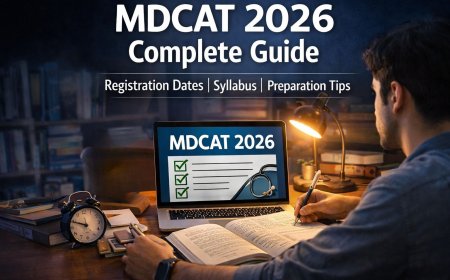


























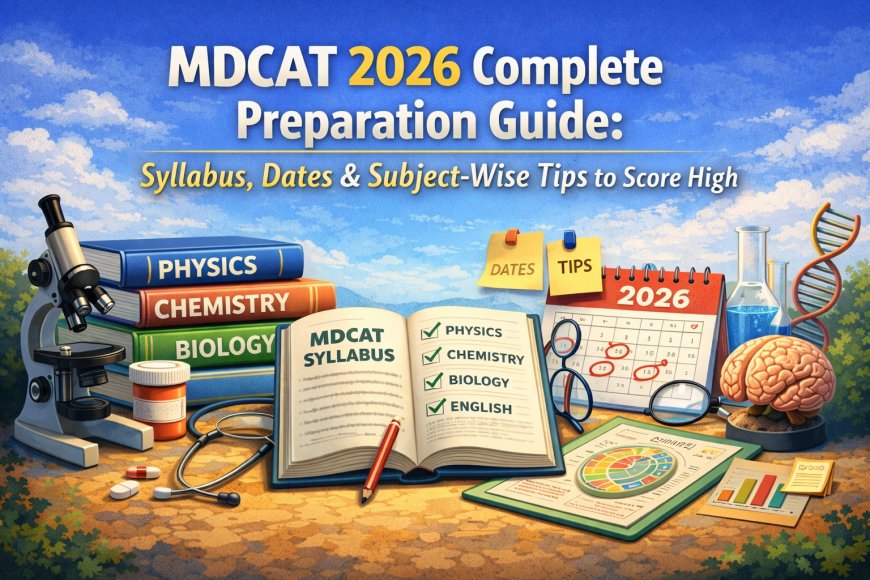
MDCAT 2026 Complete Preparation Guide: Syllabus, Dates & Subject-Wise Tips to Score High
Planning to attempt MDCAT 2026? Get the full subject-wise syllabus breakdown, expected exam dates, registration steps, and proven study tips to help Pakistani medical aspirants score high and secure their dream MBBS or BDS seat.

You studied hard for FSc. You sacrificed weekends, skipped sleep, and pushed through two years of pre-medical. Now comes the real test — the one that decides whether you get that MBBS or BDS seat, or spend another year trying. MDCAT 2026 is that test.
Over 210,000 students will compete for fewer than 6,000 MBBS seats in Punjab alone. The math is brutal. But here's the truth: most students fail not because they're not smart enough, but because they prepare without direction. They study randomly, ignore the official syllabus, and fall apart on MCQ speed.
This guide gives you everything — the correct syllabus, expected dates, registration steps, and subject-wise preparation strategies — so you start smart, not just hard.
What Is MDCAT 2026 and Who Conducts It?
MDCAT stands for Medical and Dental College Admission Test. It's the mandatory national entry test for all students seeking admission to MBBS and BDS programs in Pakistan. The Pakistan Medical and Dental Council (PMDC) oversees the syllabus and question bank, while provincial universities conduct the actual test in each province.
PMDC's admission structure means MDCAT carries 50% weight in the total merit formula, with 40% from FSc and 10% from Matric results. BilalMD A single test determines more than half your fate in admissions. That's not something you can wing.
The test is conducted once a year and assesses biology, chemistry, physics, and English through 180 multiple-choice questions with no negative marking. Wikipedia
MDCAT 2026 Expected Dates
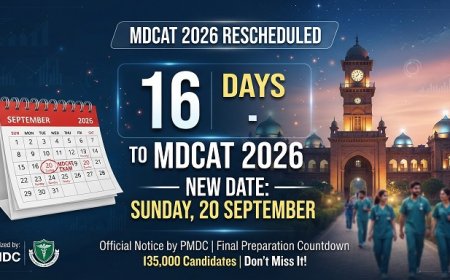
No official final date is confirmed yet, but here's what's currently known:
| Event | Expected Date |
|---|---|
| Registration Opens | August 2026 |
| Registration Closes | August 25, 2026 |
| Late Registration (Higher Fee) | Up to September 1, 2026 |
| MDCAT Test Day (Punjab/UHS) | October 2026 (Provisional) |
| NUMS Entry Test | September 28, 2026 (Expected) |
Universities across the country will conduct the test using a question bank prepared by PMDC. Biometric attendance and digital ID verification will be active at all centers. Scholarshipop
Always check pmdc.pk and your provincial conducting university for confirmed dates. Social media rumors have derailed many students' preparation timelines in past years.
MDCAT 2026 Syllabus — What You Actually Need to Study
The MDCAT 2026 syllabus covers five subjects: Biology, Chemistry, Physics, English, and Logical Reasoning. The paper consists of 200 total MCQs and runs for 180 minutes. Resultpedia
Here's the subject-wise MCQ breakdown:
| Subject | MCQs | Weightage |
|---|---|---|
| Biology | 80 | 44% |
| Chemistry | 58 | 32% |
| Physics | 32 | 18% |
| English | 18 | 10% |
| Logical Reasoning | 12 | 7% |
(Note: exact distribution varies slightly by source and may be revised. Always cross-check with the official PMDC syllabus at pmdc.pk.)
In 2025, PMDC introduced a major revision to the MDCAT syllabus structure, creating significant confusion among aspirants. Lack of clarity on sub-topics is where most students lose marks, not from missing the big chapters. Nearpeer
Who Is Eligible for MDCAT 2026?
From 2026, applicants must score a minimum of 65% in FSc Pre-Medical or an equivalent qualification to sit the MDCAT. This is increased from the previous 60% threshold. Ilmkidunya
Other eligibility points:
- Pakistani national or overseas Pakistani (different track for overseas)
- Must have Matric, Intermediate, and domicile from the same province where you intend to appear
- Students with results pending from FSc annual exams can still register
PMDC has also abolished the old 50% pass mark requirement for MDCAT. There's no pass/fail score in 2026 — only merit-based ranking applies. Scholarshipop
How to Register for MDCAT 2026
The process is fully online. Here's how it works:
Step 1: Visit the official PMDC portal at pmdc.pk or your provincial university's admissions page.
Step 2: Create an account using your CNIC and email address.
Step 3: Fill in your academic details — Matric, FSc roll number, marks, and domicile information.
Step 4: Choose your preferred test center.
Step 5: Pay the registration fee.
- Regular registration fee: Rs. 9,000. Late registration fee (up to September 1, 2026): Rs. 13,000. Ilmkidunya
Step 6: Download and save your registration confirmation.
Subject-Wise Preparation Strategy
Biology — Your Biggest MCQ Bank
Biology carries the most marks by far. Most students treat it as a reading subject. That's a mistake.
You need to understand mechanisms, not just memorize names. Cell biology, genetics, ecology, and human physiology are consistently heavy in past papers. Practice identifying key diagrams and knowing exact terminology.
Top Biology Topics:
- Cell biology and cell division
- Genetics and inheritance
- Enzymes and metabolism
- Biological molecules
- Coordination and control (nervous and endocrine systems)
- Reproduction
Chemistry — Conceptual + Numerical Balance
Chemistry requires both concept clarity and calculation speed. Organic chemistry has been increasingly weighted in recent tests. Physical chemistry calculations (equilibrium, kinetics, electrochemistry) are where students lose easy marks.
Focus areas:
- Organic reactions and mechanisms
- Chemical equilibrium
- Electrochemistry
- Solutions and concentration calculations
- Periodic table trends
Physics — Conceptual MCQs, Not Calculations
The MDCAT Physics section tests understanding, not lengthy derivations. Most MCQs are concept-based or require one-step calculations. Students who skip Physics because "it's only 30 MCQs" regret it at aggregate time.
Top Physics Topics:
- Waves and optics
- Electrostatics and current electricity
- Circular motion and forces
- Nuclear physics
English — Don't Ignore This Section
MDCAT is not just a conceptual exam — it's precision-based, and the English section tests comprehension, grammar, and vocabulary. BilalMD Many high-achieving science students neglect English and lose 10-15 marks here.
Practice reading comprehension passages at speed. Review grammar rules for sentence correction MCQs. Build vocabulary using medical and academic word lists.
Logical Reasoning — Quick Wins
This section rewards practice over study. Solve 10-15 reasoning MCQs daily. Pattern recognition improves fast with consistent drilling.
A Realistic 5-Month Study Plan (April to September 2026)
| Month | Focus |
|---|---|
| April | Complete Biology Units 1-6, Chemistry Organic |
| May | Biology Units 7-12, Physical Chemistry |
| June | Physics complete, English vocabulary + grammar |
| July | Full subject revision, past paper practice |
| August | Mock tests weekly, speed drills, weak subject revision |
| September | Final revision only — no new topics |
The rule: Study new content only until July. August and September are for practice and drilling speed.
Top Mistakes MDCAT Students Make
- Studying from off-syllabus notes circulated on WhatsApp
- Ignoring English and Logical Reasoning entirely
- Starting mock tests in August instead of July
- Not timing practice sessions
- Relying on memorization for Physics instead of understanding
Best Resources for MDCAT 2026 Preparation
| Resource | Best For |
|---|---|
| Official PMDC Syllabus (pmdc.pk) | Exact topic boundaries |
| Past MDCAT Papers (2019-2025) | Pattern familiarity |
| Nearpeer / TopGrade / Prepmed | Online mock tests and MCQ practice |
| KIPS/Dogar MCQ Books | Printed MCQ practice |
| YouTube (subject-specific channels) | Concept revision |
Always verify which platform uses the current PMDC syllabus — many older resources still carry outdated content.
MDCAT Aggregate Formula
| Component | Weightage |
|---|---|
| Matric (SSC) | 10% |
| Intermediate (FSc) | 40% |
| MDCAT Score | 50% |
A student with 85% in FSc but 140/180 in MDCAT will typically outperform a student with 90% FSc and 120/180 MDCAT at aggregate level. Your MDCAT score is the biggest lever you can pull.
FAQ — MDCAT 2026
Q1: What is the MDCAT 2026 passing score? PMDC abolished the old 50% passing criterion. In 2026, there's no fixed pass mark. Admission is purely merit-based using the aggregate formula.
Q2: Can FSc students with pending results appear in MDCAT 2026? Yes. PMDC allows students whose FSc results are still pending to register and appear in MDCAT. However, a minimum of 65% in FSc is required at the time of final admission.
Q3: How many attempts are allowed in MDCAT? There's no cap on the number of attempts. Students can appear in MDCAT in subsequent years if they don't qualify in the current year.
Q4: Is the MDCAT syllabus the same across all provinces? PMDC has set a unified syllabus and question bank. Provincial universities (UHS for Punjab, Dow for Sindh, KMU for KPK, BUMHS for Balochistan) conduct the test but from the same pool.
Q5: Is there negative marking in MDCAT 2026? No. There is no negative marking. Attempt every question.
Q6: What's the difference between MDCAT and NUMS entry test? MDCAT covers public medical colleges. NUMS (National University of Medical Sciences) conducts its own separate test for Armed Forces medical colleges. Both tests cover similar subjects but are scored and structured differently.
Q7: When does MDCAT registration open in 2026? Registration is expected to open in August 2026. Confirm the exact date on the official PMDC or provincial university portal.
References & Citations
- PMDC Official Syllabus. Pakistan Medical and Dental Council. pmdc.pk
- MDCAT In Pakistan: Complete Guide For Students 2026. bilalmd.com
- Medical and Dental College Admission Test. Wikipedia (Updated January 2026). en.wikipedia.org
- PMDC MDCAT Test 2026 Complete Guide. ilmkidunya.com
- MDCAT 2026 Syllabus (Official Update). Nearpeer Blog (February 2026). nearpeer.org
- NMDCAT 2026 Preparation Guide. TopGrade.pk
What's Your Reaction?
 Like
0
Like
0
 Dislike
0
Dislike
0
 Love
0
Love
0
 Funny
0
Funny
0
 Angry
0
Angry
0
 Sad
0
Sad
0
 Wow
0
Wow
0