





















MDCAT 2026 Complete Guide: Registration Dates, Syllabus, and Preparation Tips
Everything Pakistani pre-medical students need to know about MDCAT 2026 — registration dates, PMDC syllabus, exam pattern, fees, and top preparation tips to score high.

You studied day and night for two years. You gave up weekends. You sat through hours of FSc lectures, telling yourself it would all pay off. And now, MDCAT is the one door standing between you and a seat in medical college.
The problem? Most students don't know where to start. The syllabus feels massive. The competition is brutal. And every year, thousands of pre-medical students walk into MDCAT without a proper plan and walk out devastated.
This guide changes that. Here's everything you need to know about MDCAT 2026 — from registration to syllabus to a preparation strategy that actually works.
What Is MDCAT and Why Does It Matter?
MDCAT stands for Medical and Dental College Admission Test. It's the single national-level entry test you must pass to get into any MBBS or BDS program in Pakistan — whether public or private.
Around 210,000 students appear in MDCAT every year, competing for a limited number of medical seats. Scholarshipop In Punjab alone, there are approximately 6,000 MBBS seats across public and private medical colleges. Scholarshipop
Think about that number. Over 200,000 students. A few thousand seats. That ratio alone tells you why preparation — not just attendance — is what separates students who get in from those who don't.
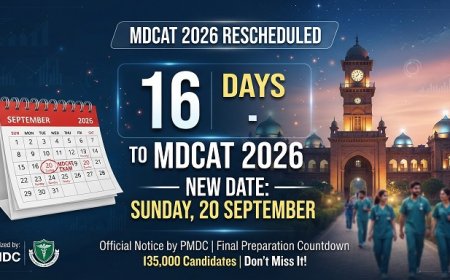
MDCAT 2026 Key Dates at a Glance
Here's what the expected MDCAT 2026 schedule looks like:
| Event | Expected Date |
|---|---|
| Registration Opens | August 8, 2026 |
| Last Date (Regular Fee) | August 25, 2026 |
| Late Registration Deadline | September 1, 2026 |
| MDCAT Exam Date | October 5–26, 2026 (varies by province) |
The standard MDCAT registration fee is Rs. 9,000. If you miss the deadline and register late, the fee jumps to Rs. 13,000. Ilmkidunya The fee is non-refundable under any circumstances.
Registration is done entirely online through the official PMDC/PMC portal at pmdc.pk.
Who Can Apply for MDCAT 2026?
Basic Eligibility Criteria
From 2026 onwards, applicants must score a minimum of 65% in FSc Pre-Medical (or equivalent) to sit the MDCAT. Ilmkidunya This is an increase from the previous 60% threshold.
Other requirements:
- You must have studied Biology, Chemistry, and Physics at FSc level
- Students with results still pending can also apply
- Pakistani nationals, dual nationals, and overseas Pakistanis are all eligible
- Your matriculation, intermediate, and domicile certificate must belong to the same province where you're appearing in MDCAT
MDCAT 2026 Exam Pattern: What to Expect
Structure of the Test
The MDCAT 2026 test is entirely MCQ-based with 200 multiple-choice questions to be completed in 180 minutes. Resultpedia
Here's the subject-wise breakdown:
| Subject | No. of MCQs |
|---|---|
| Biology | 80 |
| Chemistry | 60 |
| Physics | 40 |
| English | 20 |
The syllabus covers Biology, Chemistry, Physics, English, and Logical Reasoning — all based on the FSc curriculum. Ilmkidunya Every MCQ comes directly from within this syllabus. Going outside it wastes your time.
One question = roughly 54 seconds. That's your reality. Speed and accuracy both matter here.
MDCAT 2026 Syllabus: What PMDC Wants You to Know
How the Syllabus Works
PMDC has set a centralized MDCAT syllabus applicable to all provinces. Scholarshipop No matter which board you studied under, the same topics apply. Download the official PMDC MDCAT 2026 syllabus PDF directly from pmdc.pk — it's your single most important document.
Key Topics Per Subject
Biology (80 MCQs — your biggest weapon) Focus on: Cell Biology, Genetics, Biotechnology, Human Physiology, Biodiversity, Evolution. These topics carry the most marks and are also the most concept-heavy.
Chemistry (60 MCQs) Focus on: Organic Chemistry, Chemical Equilibrium, Electrochemistry, Reaction Mechanisms. Most students lose marks here due to formula confusion. Practice calculations daily.
Physics (40 MCQs) Focus on: Mechanics, Waves, Electromagnetism, Modern Physics. Apply formulas in context — rote memorization won't help here.
English (20 MCQs) Focus on: Reading comprehension, grammar, vocabulary. Don't neglect this section. It's the easiest 20 marks on the paper.
MDCAT 2026 Registration Process: Step by Step
How to Register Online
- Go to pmdc.pk (the official PMDC portal)
- Create your account using your CNIC or B-Form
- Fill in your academic details (matric, FSc marks, board)
- Select your preferred test city and exam center
- Download the fee challan
- Pay Rs. 9,000 at your nearest MCB bank branch
- Upload payment confirmation (it uploads automatically via PMDC's system)
- Download and save your registration confirmation
Which University Conducts MDCAT in Which Province?
MDCAT 2026 will be conducted by provincial universities using a syllabus and question bank prepared by PMDC. Scholarshipop
- Punjab: University of Health Sciences (UHS), Lahore
- Sindh: Dow University of Health Sciences (DUHS), Karachi
- KPK: Khyber Medical University (KMU), Peshawar (via ETEA)
Each university follows the PMDC syllabus and question bank — so the content is the same, even if the conducting body differs.
MDCAT 2026 Preparation Strategy: A Month-by-Month Plan
Where Should You Start? (April–May 2026)
You have roughly 6 months before the test. That's actually enough time — if you use it right.
Month 1-2 (April–May): Build your foundation. Go through every FSc chapter topic-by-topic. Don't skip anything. Use your PMDC syllabus as your checklist.
Month 3 (June): Start solving past papers. MDCAT 2025, 2024, 2023. Notice which topics repeat. Focus your revision there.
Month 4 (July): Start timed mock tests. Full 200 MCQs in 180 minutes. Treat it like the real thing. Analyze every mistake immediately.
Month 5 (August): Intensive revision. Focus only on your weak areas. Redo past paper questions you got wrong.
Month 6 (September–October): Light revision only. Mental preparation matters just as much as content revision at this stage.
Top Preparation Tips That Actually Work
Study Smarter, Not Harder
1. Don't study subjects — study MCQs. MDCAT tests application, not memorization. After reading a concept, immediately test yourself with 10 MCQs on it.
2. Use the PMDC question bank. The official question bank is your best practice resource. Everything in the exam comes from this pool.
3. Time yourself every single session. Get used to answering questions fast. Slow students run out of time and lose marks on questions they actually know.
4. Biology is your biggest point scorer. With 80 MCQs, it's 40% of your paper. Never compromise time on Biology.
5. Don't ignore English. Most students skip it during preparation. Then they lose 5–8 easy marks on exam day. Don't be that student.
6. Join a study group — but a focused one. A group of 3–4 serious students who quiz each other daily is worth more than 10 hours of solo reading.
Common MDCAT Mistakes (and How to Avoid Them)
Mistake #1: Studying outside the syllabus. If it's not in the PMDC syllabus, it won't be in the paper. Period.
Mistake #2: Skipping mock tests. Students who don't practice full-length papers under time pressure consistently underperform. It's that simple.
Mistake #3: Starting revision in August. By August, you should be in practice mode — not learning mode. Start now.
Mistake #4: Trusting social media for syllabus updates. Only trust the official PMDC website. Rumors about syllabus changes spread every year and waste students' precious time.
What Score Do You Need to Get Into Medical College?
A typical MBBS program requires around 200 marks in MDCAT, depending on the university. Topgrade
The passing criteria for MBBS is 60% marks in MDCAT. Scholarshipop But "passing" and "getting a seat" are two different things. Public medical colleges in Punjab require scores well above 80% due to high competition.
Target 160+ if you want a real shot at a public medical college seat.
Frequently Asked Questions (FAQ)
Q: What is the MDCAT 2026 exam date? The MDCAT 2026 is expected to be held on October 5–26, 2026, depending on the province. PMDC will announce the confirmed date officially.
Q: What is the MDCAT 2026 registration fee? The standard fee is Rs. 9,000. Late registration (after August 25) costs Rs. 13,000. The fee is non-refundable.
Q: What subjects are in MDCAT 2026? Biology (80 MCQs), Chemistry (60 MCQs), Physics (40 MCQs), and English (20 MCQs). Total: 200 questions in 180 minutes.
Q: Can I appear in MDCAT if my FSc result is still pending? Yes. Students awaiting their FSc results can apply and appear in MDCAT.
Q: How many times can I attempt MDCAT? There is no limit on the number of MDCAT attempts.
Q: Is the MDCAT syllabus the same for all provinces? Yes. PMDC has set a unified, national syllabus for all provinces.
Q: Where do I register for MDCAT 2026? Only through the official PMDC portal: pmdc.pk. Do not trust third-party websites for registration.
Q: What is the minimum FSc percentage needed for MDCAT 2026? 65% in FSc Pre-Medical (or equivalent).
References
- Pakistan Medical and Dental Council (PMDC) — pmdc.pk
- Ilmkidunya — MDCAT Registration 2026 Guide — ilmkidunya.com/mcat
- ScholarshipOP — PMDC MDCAT 2026 Guide — scholarshipop.com
- TopGrade.pk — NMDCAT 2026 Preparation — topgrade.pk
- Resultpedia — MDCAT 2026 Syllabus — result-pedia.net
What's Your Reaction?
 Like
0
Like
0
 Dislike
0
Dislike
0
 Love
0
Love
0
 Funny
0
Funny
0
 Angry
0
Angry
0
 Sad
0
Sad
0
 Wow
0
Wow
0