
























MDCAT 2026: Dates, Eligibility, Syllabus and How to Start Preparing Right Now
MDCAT 2026 is expected on October 26. Registration opens August 8. Here's everything Pakistani pre-medical students need to know — dates, eligibility changes, syllabus breakdown, and a practical 6-month study plan.

You picked Pre-Medical. You told yourself medicine is the plan. And now it's April — and the thought sitting quietly in the back of your head is: "Am I actually prepared for MDCAT?"
Here's the honest truth. Around 200,000 students appear in MDCAT every year, making it one of the most competitive exams in the country. Scholarshipop Last year, that number grew by 70,000 in a single cycle. Every one of them has a family that expects a doctor. Every one of them is studying the same books. The students who make it aren't smarter — they start earlier and study smarter.
April is the right time to start. Registration opens in August. That gives you four to six months of prep time. This guide will tell you exactly what to prepare for, when to register, and how to structure those months.
What Is MDCAT?
MDCAT stands for Medical and Dental College Admission Test. It's a standardized entrance exam required for admission to all public and private medical and dental colleges in Pakistan. Its purpose is to ensure merit-based admissions by assessing academic ability and reasoning skills. Ilmkidunya
It's conducted by PMDC (Pakistan Medical and Dental Council) at the national level, with provincial bodies like UHS (Punjab), ETEA (KPK), and Dow University (Sindh) running provincial tests.
MDCAT 2026 Key Dates
| Event | Expected Date |
|---|---|
| Registration Opens | August 8, 2026 |
| Late Registration Closes | September 1, 2026 |
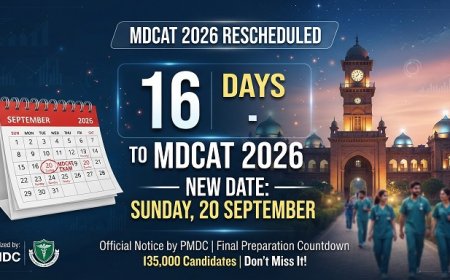
| MDCAT Test Date | October 26, 2026 (Sunday) |
| Result (Expected) | Within 2 weeks of test |
| Answer Key Release | 6–8 hours after test |
| MBBS Admission Deadline (Punjab) | November 30, 2026 |
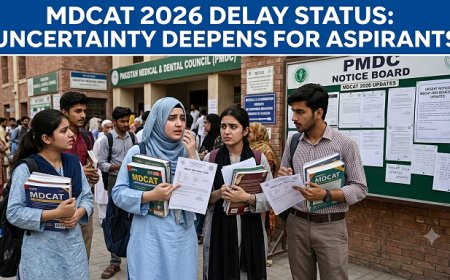
The PMDC has officially rescheduled the MDCAT 2026 in light of unforeseen circumstances. The test, initially set for October 5, was moved to October 26, 2026. Ilmkidunya Keep checking pmdc.pk for the latest confirmed dates.
MDCAT 2026 Eligibility: What's Changed
PMDC updated the eligibility rules for 2026. Read carefully — this affects many students.
Since 2026, applicants are required to score a minimum of 65% in FSc (Pre-Medical) or an equivalent certificate to take the MDCAT test. Previously, this threshold was 60%. Ilmkidunya
PMDC has also introduced a provincial alignment policy, which requires the applicant to have their matriculation, intermediate, and domicile certificate from the same province where they intend to take the MDCAT. Ilmkidunya
Here's a summary of 2026 eligibility requirements:
| Requirement | Detail |
|---|---|
| Academic Background | FSc Pre-Medical (Biology, Chemistry, Physics) |
| Minimum FSc Marks | 65% (changed from 60%) |
| Age | No upper limit stated by PMDC |
| Province Match | Matric, Inter, and domicile must match the province of the MDCAT centre |
| Attempts | One attempt per calendar year |
| FSc Result Required? | No — result-awaiting students can also apply |
MDCAT Registration 2026: How to Apply
The registration fee for MDCAT 2026 is Rs. 9,000 (standard). Students who register late — up to September 1 — pay Rs. 13,000. Ilmkidunya
Registration steps:
- Go to pmdc.pk and create/log into your account.
- Complete your personal and academic details.
- Choose your test centre city and environment preference.
- Pay via online banking, debit/credit card, or bank challan.
- Download your roll number slip after payment confirmation.
Documents you'll need ready:
- CNIC or B-Form
- Recent passport-sized photo
- FSc result card or enrolment letter (for result-awaiting students)
- Domicile certificate
MDCAT 2026 Exam Format
The total time for the national MDCAT test is 3.5 hours (210 minutes). Students have to complete 200 multiple-choice questions. There is no negative marking. Scholarshipop
| Section | MCQs |
|---|---|
| Biology | 68 |
| Chemistry | 54 |
| Physics | 54 |
| English & Logical Reasoning | 21 + 3 = 24 |
| Total | 200 |
No negative marking means you should attempt every single question. Leaving a question blank is always a loss.
Passing Marks for MDCAT 2026
Students meeting these criteria qualify to apply for MBBS/BDS admissions: ACAD
- MBBS (Public Medical Colleges): Minimum 55% — 110 out of 200
- BDS (Dental Colleges): Minimum 50% — 100 out of 200
However, passing minimums don't get you into a good college. A good score opens doors to prestigious institutions like King Edward Medical University, Aga Khan University, and Fatima Jinnah Medical College. ACAD Historically, top public medical college seats close at 80–90%+ aggregates. Aim for 170+ out of 200.
MDCAT Merit Formula: How Aggregate Is Calculated
| Component | Weightage |
|---|---|
| MDCAT Score | 50% |
| FSc Marks | 40% |
| Matric Marks | 10% |
Example: If you score 170/200 in MDCAT, 1050/1100 in FSc, and 478/500 in Matric, your aggregate works out to approximately 84–85%. That places you in the competitive zone for many public medical colleges.
MDCAT 2026 Syllabus Overview
The MDCAT syllabus is based on Federal and Punjab Board FSc curriculum. Key chapters include:
Biology (Most Weightage)
- Cell biology and genetics
- Biological molecules
- Reproduction in organisms
- Kingdom Animalia (chordata)
- Nervous system and homeostasis
Chemistry
- Organic chemistry (reactions, mechanisms)
- Atomic structure
- Chemical equilibrium
- Electrochemistry
- Environmental chemistry
Physics
- Waves and sound
- Modern physics
- Electrostatics
- Alternating current
- Nuclear physics
English (SAT-style passages)
- Reading comprehension
- Grammar and vocabulary
- Sentence correction
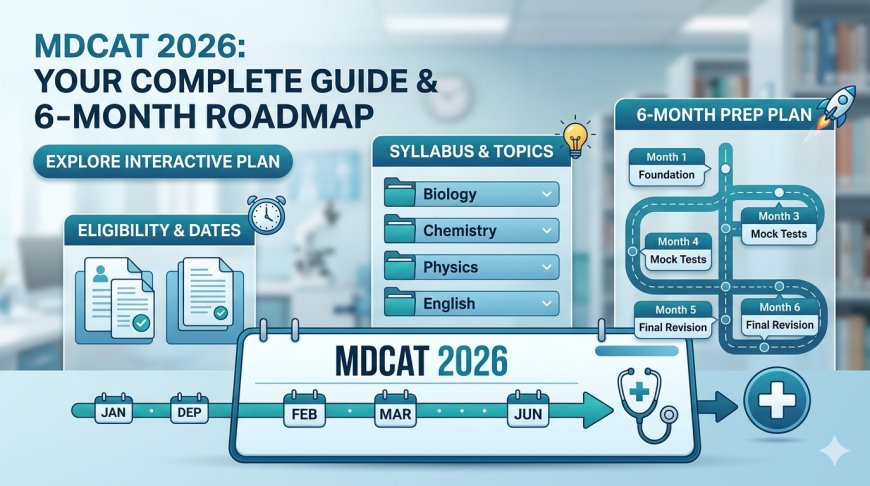
6-Month MDCAT Preparation Plan (April–October 2026)
You have roughly six months from today. Here's how to use them:
Month 1–2 (April–May): Foundation Phase
This is where most students rush and most students fail. Don't rush.
- Read your FSc books cover to cover. Don't skip definitions. MDCAT tests exact terminology.
- Make short notes for each chapter — one page per major topic.
- Focus on Biology and Chemistry first. They carry 122/200 MCQs combined.
Daily target: 4–5 hours of study. One subject per day. No MCQ practice yet.
Month 3–4 (June–July): MCQ Practice Phase
Now you apply what you learned.
- Start solving past MDCAT papers (2019–2025 available online and in bookshops).
- Use KIPS, Nmdcat, and PMC official question banks.
- Time yourself. Practise completing 200 MCQs in 210 minutes.
- Track weak chapters and go back to revise them within the same week.
Daily target: 3 hours revision + 2 hours MCQ practice.
Month 5 (August): Registration + Full Mock Tests
- Complete your PMDC registration in August (opens August 8).
- Take at least one full mock test per week under real exam conditions.
- Simulate the centre environment: no phone, no breaks, 210 minutes straight.
Daily target: Full test every 7 days. Error analysis the next day.
Month 6 (September–October): Revision + Mental Prep
- No new topics. Only revision.
- Focus on your weakest chapters and highest-weightage Biology topics.
- Sleep well. Rest is preparation too.
- Attend at least two final mock tests in the 2 weeks before October 26.
How Many Seats Are There in Public Medical Colleges?
There are 6,000 MBBS seats in public and private medical colleges in Punjab, and 775 BDS seats. Scholarshipop
Pakistan overall has 74 private medical colleges and 48 public medical colleges affiliated with PMDC. Ilmkidunya Competition is intense for public seats because the fees are subsidised. Private medical college fees can reach Rs. 800,000 per semester or more.
Should You Take Coaching or Study on Your Own?
Both approaches work. The real answer depends on your discipline.
Coaching benefits:
- Structured schedule
- Regular tests
- Expert explanation of tricky concepts
- Peer pressure that keeps you consistent
Self-study benefits:
- Flexible timing
- Cheaper
- You control the pace
- Better for students who've already covered their FSc well
Many high scorers use a hybrid: attend a coaching centre for tests and mock exams only, and self-study for content. That's worth considering.
FAQs: MDCAT 2026
Q: When is the MDCAT 2026 test date? The MDCAT 2026 is expected on October 26, 2026 (Sunday). Confirm the final date on pmdc.pk once announced in mid-2026.
Q: When does MDCAT 2026 registration open? Registration is expected to open August 8, 2026. Late registration runs until September 1, 2026, at a higher fee.
Q: What is the eligibility for MDCAT 2026? You need FSc Pre-Medical with a minimum of 65% marks. Your Matric, Inter, and domicile must all be from the same province where you plan to sit the test.
Q: Is there negative marking in MDCAT 2026? No. You should attempt all 200 questions. A blank answer and a wrong answer both give zero marks.
Q: Can Class 11 (Part 1) students apply for MDCAT? Yes. MDCAT registration doesn't require your FSc result. Result-awaiting students can register and sit the test. However, you'll need FSc results before final medical college admission.
Q: What is the MDCAT registration fee for 2026? Rs. 9,000 for standard registration. Rs. 13,000 if registered late (after the deadline, before September 1).
Q: How many times can you take MDCAT? Once per calendar year. If you don't qualify in 2026, you can try again in 2027.
Q: What score do I need for King Edward Medical University? Historically, KEMU's closing aggregate is 88–92%+. You'll need a high MDCAT score (around 180+/200) and strong FSc marks.
References and Citations
- PMDC Official Website — pmdc.pk
- MDCAT 2026 Date and Registration — ilmkidunya.com/mcat
- MDCAT 2026 Guide — ldacity.com.pk/mdcat-registration
- MBBS Admissions in Pakistan 2026 — ilmkidunya.com/mbbs/admissions.aspx
- PMDC MDCAT Complete Guide — scholarshipop.com/blog/pmdc-mdcat
- University of Health Sciences (UHS) official announcements — uhs.edu.pk
What's Your Reaction?
 Like
1
Like
1
 Dislike
0
Dislike
0
 Love
1
Love
1
 Funny
0
Funny
0
 Angry
0
Angry
0
 Sad
0
Sad
0
 Wow
0
Wow
0