





















HEC Indigenous PhD Fellowships 2026: Eligibility, Benefits and How to Apply
HEC Indigenous PhD Fellowships 2026: full tuition and monthly stipend for Pakistani scholars in public universities. Check eligibility, deadlines and how to apply.

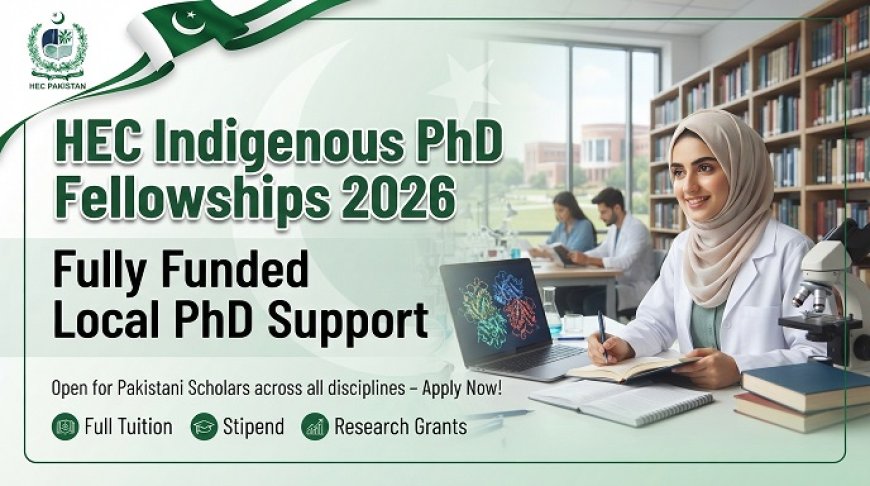
The Higher Education Commission (HEC) has opened applications for new Indigenous PhD Fellowships, aimed at supporting Pakistani and AJK scholars pursuing full-time PhD degrees in public-sector universities across Pakistan.pakistantimes+1
This scheme provides full tuition coverage and a monthly living stipend for selected candidates, making it one of the most important domestic funding options for final-year Master’s students and early-stage PhD researchers.pakistantimes
Applications must be submitted through the official HEC scholarship portal before the announced closing date for the 2026 intake.pakistantimes+1
This guide explains:
-
Who is eligible for HEC Indigenous PhD Fellowships 2026
-
What the fellowship covers (tuition, stipend, duration, conditions)
-
Step-by-step application process via the HEC portal
-
Common mistakes that lead to rejection and how to avoid them
What Are HEC Indigenous PhD Fellowships?
Short answer: HEC Indigenous PhD Fellowships are domestic scholarships that fund full-time PhD studies in HEC-recognised public-sector universities in Pakistan for eligible Pakistani and AJK nationals.pakistantimes+1
Key features:
-
Scope: Supports PhD scholars studying within Pakistan (as opposed to overseas schemes).
-
Target group: High-potential researchers in priority fields aligned with national needs (e.g., engineering, sciences, agriculture, health, social sciences, IT).
-
Funding model: Typically covers tuition fees and provides a monthly stipend for the approved duration of the PhD programme.pakistantimes
-
Administration: Managed through HEC’s scholarship system, with universities playing a key role in admission, supervision and progress monitoring.
The term “indigenous” here refers to local, domestic PhD support (not ethnicity-based). It is designed to strengthen Pakistan’s research capacity by funding scholars who will work and contribute within the country.pakistantimes+1
Who Is Eligible for the HEC Indigenous PhD Fellowship 2026?
One-line summary: Pakistani and AJK nationals with a relevant Master’s/MS/MPhil degree, strong academic record, and admission (or eligibility for admission) to a public-sector PhD programme can apply, subject to age and employment conditions.
While exact criteria can vary slightly by call, typical eligibility requirements for HEC Indigenous PhD Fellowships include:
1. Nationality and Domicile
-
Must be a Pakistani or AJK national.
-
Some calls require candidates to be permanent residents of Pakistan and not hold dual nationality (especially where linked to certain government-funded schemes).theopportunity
2. Academic Qualification
-
Hold a relevant MS/MPhil or equivalent (18 years of education) in the proposed field of PhD research.
-
Strong academic record, often with:
-
Minimum CGPA 3.0/4.0 or First Division in the terminal degree
-
No more than the allowed number of second divisions in earlier degrees (commonly maximum one second division before the terminal degree).pakistantimes
-
3. PhD Admission Status
-
Must have:
-
Secured admission to a PhD programme in an HEC-recognised public-sector university, or
-
Be in the process of obtaining admission, with clear evidence of eligibility and intent to enrol full-time.
-
Some intakes prioritise candidates who are already enrolled in the first year of their PhD, while others allow pre-admission applicants who will join in the upcoming semester.
4. Age Limits
Typical age criteria (based on recent HEC PhD schemes):
-
General category: Up to 35–40 years (varies by specific call)
-
Public-sector employees (universities, R&D, government/semi-government): Often allowed up to 40–45 years
Always check the specific advertisement for the exact age limit applicable to the 2026 Indigenous PhD Fellowship.pakistantimes
5. Employment and NOC
-
Working candidates (in public or private sector) usually must provide a No-Objection Certificate (NOC) from their employer.
-
Some schemes require candidates to be regular employees of public-sector institutions to qualify for certain categories or age relaxations.pakistantimes
6. Other Conditions
-
Must not be availing another full-time scholarship for the same degree.
-
Must commit to full-time research and comply with HEC’s PhD policy (coursework, comprehensive exam, dissertation, publications).
What Does the HEC Indigenous PhD Fellowship Cover?
Short answer: Selected scholars receive full tuition coverage and a monthly stipend for the approved duration of their PhD, subject to HEC rules and satisfactory progress.
Typical benefits:
-
Tuition fees:
-
Covered as per HEC-approved rates for the PhD programme at the host public university.
-
If the university’s fee exceeds the HEC cap, the scholar or university may need to cover the difference.pakistantimes
-
-
Monthly stipend:
-
A fixed living allowance paid monthly (amounts vary by scheme and revision; recent HEC PhD schemes report stipends in the range of Rs 60,000–100,000+ per month, depending on category and discipline).
-
Stipend is usually contingent on satisfactory academic progress and compliance with HEC/university requirements.pakistantimes+1
-
-
Duration:
-
Support is typically provided for the normal duration of the PhD (e.g., 3–5 years), subject to:
-
Annual progress reviews
-
HEC and university approval
-
Availability of funds
-
-
-
Additional support (scheme-dependent):
-
Possible support for:
-
Research-related travel (conferences, fieldwork)
-
Thesis-related expenses
-
HEC-mandated training/workshops
-
-
Exact amounts and conditions are defined in the official notification and fellowship agreement; candidates should read these carefully before applying.
How to Apply for HEC Indigenous PhD Fellowships 2026 (Step-by-Step)
Short answer: Register on the HEC scholarship portal, complete your profile, select the Indigenous PhD Fellowship, upload documents, and submit before the deadline.
Steps:
-
Open the HEC scholarship portal:
-
Go to:
https://scholarships.hec.gov.pkorhttps://eservices.hec.gov.pk(as specified in the advertisement).pakistantimes+1
-
-
Create or log in to your account:
-
Use your CNIC number (without dashes) to register.
-
Verify your mobile number and email via OTP.theopportunity
-
-
Complete your profile:
-
Enter:
-
Personal details (name, CNIC, contact, domicile)
-
Academic history (degrees, CGPA, institutions, years)
-
Employment history (if applicable)
-
Research experience, publications, conferences (if any)
-
-
Upload scanned copies of:
-
CNIC
-
Degrees and transcripts (BS/MSc, MS/MPhil)
-
Any equivalence certificates (for foreign degrees)theopportunity
-
-
-
Select the Indigenous PhD Fellowship 2026:
-
From the list of scholarships, choose:
-
Indigenous PhD Fellowship (or similarly named local PhD scheme for 2026).
-
-
Ensure you select the correct intake/batch as per the advertisement.
-
-
Enter PhD and research details:
-
Provide:
-
Name of the public-sector university
-
Department and proposed research area/topic
-
Supervisor’s name and designation (if already assigned)
-
Admission status (admitted/result-awaiting/planning to apply)
-
-
Upload:
-
Admission letter (if already admitted)
-
Research proposal (if required)
-
Any NOC from employer (if employed)pakistantimes+1
-
-
-
Pay the application processing fee (if applicable):
-
Some HEC scholarship calls require a non-refundable processing fee (e.g., Rs 3,000) via 1LINK or other online payment options.
-
Check whether the Indigenous PhD Fellowship 2026 requires a fee; if yes, complete payment and upload/save the receipt.pakistantimes
-
-
Review and submit:
-
Carefully check all entered data and uploaded documents.
-
Ensure your research area, university and category match the eligibility criteria.
-
Submit the application before the announced deadline.
-
-
Track your application status:
-
Log in to the HEC portal to monitor:
-
Scrutiny status
-
Interview shortlisting
-
Award notifications
-
-
You can also track status using your CNIC on the HEC e-portal as described in official guidance.pakistaninfohub+1
-
Common Mistakes That Lead to Rejection (And How to Avoid Them)
Short answer: Most rejections come from incomplete forms, mismatched eligibility, weak documentation and missed deadlines. Fix these before you submit.
1. Incomplete or Inconsistent Profile
-
Mistake: Leaving fields blank, entering wrong CGPA, or mismatching degree names with transcripts.
-
Fix:
-
Cross-check every entry against your original documents.
-
Ensure CGPA/percentage and degree titles match your mark sheets exactly.
-
2. Wrong Scholarship Category or Intake
-
Mistake: Selecting an overseas scheme instead of Indigenous, or applying under an old batch.
-
Fix:
-
Read the advertisement title carefully: “Indigenous PhD Fellowship 2026”.
-
Confirm the batch/intake year and that you are applying for local PhD, not overseas.
-
3. Missing or Unclear Documents
-
Mistake: Uploading blurry scans, partial transcripts, or missing NOC/admission letters.
-
Fix:
-
Use clear, colour scans in the specified format and size.
-
Include all pages of transcripts and degree certificates.
-
If employed, attach a properly signed NOC on official letterhead.pakistantimes
-
4. Not Meeting Eligibility Criteria
-
Mistake: Applying with:
-
Less than 18 years of education
-
More than the allowed number of second divisions
-
Age above the limit for your category
-
-
Fix:
-
Re-read the eligibility section in the official notification.
-
If unsure, contact your university’s HEC scholarship focal person or HEC support before applying.
-
5. Weak or Generic Research Proposal
-
Mistake: Submitting a vague, copied or overly broad proposal with no clear problem statement or methodology.
-
Fix:
-
Write a focused proposal with:
-
Clear research question
-
Brief literature context
-
Proposed methodology
-
Expected contribution to the field and Pakistan
-
-
Align your topic with national priority areas where possible.theopportunity
-
6. Late Submission
-
Mistake: Starting the application close to the deadline and failing to submit on time.
-
Fix:
-
Begin at least 3–5 days before the deadline.
-
Complete payment and document upload early; use the final day only for review.
-
Indigenous vs Overseas: Which HEC PhD Scheme Should You Choose?
If your goal is to build a research career in Pakistan, work closely with local institutions and contribute directly to national projects, the Indigenous PhD Fellowship is often the better fit. If you aim for international exposure and global networks, consider HEC’s overseas PhD schemes alongside domestic options.pakistantimes+1
Myth vs Fact: HEC Indigenous PhD Fellowships
Myth 1: “Indigenous PhD Fellowships are only for ethnic minorities.”
Fact: “Indigenous” here means local/domestic PhD support within Pakistan, not ethnicity-based eligibility. The scheme is open to all eligible Pakistani and AJK nationals.eliteopportunities
Myth 2: “I can apply after the deadline if my university supports me.”
Fact: HEC scholarship portals typically close strictly at the announced deadline; late applications are not accepted, even with university backing.pakistantimes
Myth 3: “Once selected, I get funding for the entire PhD without any conditions.”
Fact: Funding is conditional on satisfactory progress, annual reviews, compliance with HEC PhD policy and university requirements; poor performance can lead to suspension or termination.pakistantimes
E-E-A-T Reinforcement (Credibility Note)
This article is based on:
-
Official-style announcements and summaries of HEC Overseas and domestic PhD schemes, including eligibility, age limits, tuition and stipend structures, and portal-based application processes.pakistantimes+2
-
Standard HEC practices for scholarship portals, document scrutiny, NOC requirements for employed candidates and progress-based stipend continuation.pakistantimes+1
-
Widely reported patterns for HEC PhD funding (tuition coverage, monthly stipend ranges, public-sector university focus) in Pakistani education media.pakistantimes+1
ilmiworld.com cross-checks such scholarship details against official HEC communications and credible education sources before publishing. Where specific 2026 Indigenous PhD Fellowship notifications (exact stipend amounts, precise age limits, deadline dates) are not fully visible in the public domain at the time of writing, we clearly frame the information as typical of HEC PhD schemes and direct students to the official HEC portal and advertisement for final confirmation.
FAQ Section
1. What is the HEC Indigenous PhD Fellowship 2026?
It is a domestic scholarship by HEC that supports eligible Pakistani and AJK scholars pursuing full-time PhD degrees in public-sector universities in Pakistan, covering tuition and providing a monthly stipend.pakistantimes+1
2. Who can apply for the HEC Indigenous PhD Fellowship?
Pakistani and AJK nationals with a relevant MS/MPhil (18 years), strong academic record, and admission (or eligibility for admission) to a PhD programme in a public-sector university, subject to age and employment conditions.pakistantimes
3. What does the HEC Indigenous PhD Fellowship cover?
It typically covers full tuition fees and provides a monthly living stipend for the approved duration of the PhD, subject to satisfactory progress and HEC/university rules.pakistantimes
4. How do I apply for the HEC Indigenous PhD Fellowship 2026?
Register on the HEC scholarship portal (scholarships.hec.gov.pk or eservices.hec.gov.pk), complete your profile, select the Indigenous PhD Fellowship, upload documents, and submit before the deadline.pakistantimes+1
5. Is there an age limit for HEC PhD fellowships?
Yes. Typical age limits are around 35–40 years for general candidates and up to 40–45 years for public-sector employees, but exact limits depend on the specific 2026 call.pakistantimes
6. Do I need to be already admitted to a PhD programme to apply?
Most intakes prefer or require candidates to have secured admission or be in the final stages of admission to a PhD programme in a public-sector university. Check the specific advertisement for exact requirements.
7. Can employed candidates apply for the HEC Indigenous PhD Fellowship?
Yes, but they usually must provide a No-Objection Certificate (NOC) from their employer, and some categories may prioritise public-sector employees.pakistantimes
8. Is the HEC Indigenous PhD Fellowship available for private universities?
No. This scheme is designed for PhD scholars in HEC-recognised public-sector universities in Pakistan.
9. How can I track my HEC PhD scholarship application status?
Log in to the HEC e-portal with your CNIC to check scrutiny status, interview shortlisting and award notifications, as per HEC’s standard process.pakistaninfohub+1
10. Where can I find the official HEC Indigenous PhD Fellowship 2026 notification?
On the HEC website (hec.gov.pk) under Scholarships & Grants and on the HEC scholarship portal, as well as via official university notifications and HEC social media channels.pakistantimes+1
Conclusion
HEC Indigenous PhD Fellowships 2026 offer a major opportunity for Pakistani and AJK scholars to pursue fully funded PhD studies in public-sector universities, with tuition coverage and a monthly stipend.pakistantimes+1
Next steps:
-
Verify your eligibility (degree, age, admission status, employment/NOC).
-
Prepare your documents (degrees, transcripts, CNIC, NOC, research proposal, admission letter).
-
Apply through the official HEC scholarship portal before the announced deadline, double-checking all entries to avoid common rejection mistakes.
What's Your Reaction?
 Like
0
Like
0
 Dislike
0
Dislike
0
 Love
0
Love
0
 Funny
0
Funny
0
 Angry
0
Angry
0
 Sad
0
Sad
0
 Wow
0
Wow
0