












Best BS Degrees in Pakistan 2026: High-Scope Fields After FSc, ICS and FA
Compare the best BS degrees in Pakistan 2026 by demand, skills, accreditation, career options and fit after FSc, ICS or FA.

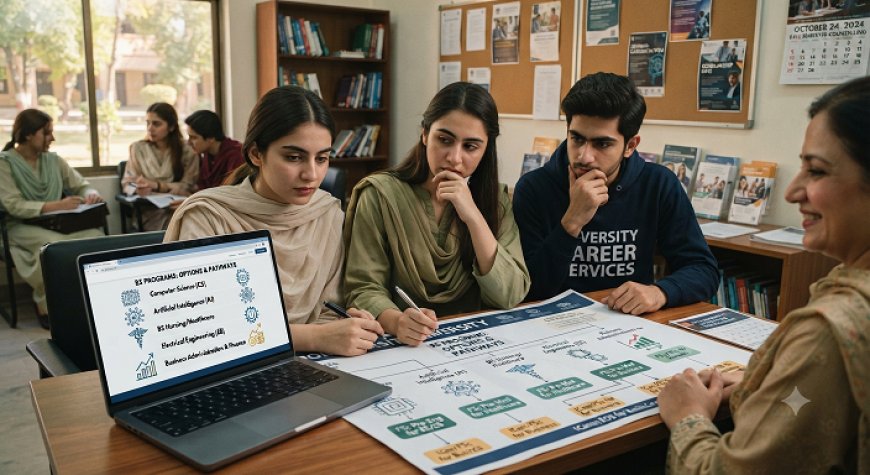
Quick answer: For 2026, strong degree choices include Computer Science, Software Engineering, Artificial Intelligence, Data Science, Cybersecurity, Electrical Engineering, Nursing and other Allied Health Sciences, Accounting and Finance, and Business with a specialised skill. No degree guarantees a high salary; university quality, accreditation, practical skills, internships, English communication and portfolio work often matter as much as the degree title.
Choosing a Degree After Intermediate
The best degree is not simply the one with the highest advertised salary. A sensible choice should match four factors:
Your Intermediate subjects and entry-test eligibility.
Your ability and interest in the subject.
The quality and accreditation of the university programme.
The skills and jobs available after graduation.
A computing degree can lead to software, data or security work, but it demands regular coding practice. A health degree can offer a clear professional route, but may involve licensing, clinical training and longer study. Engineering can open technical careers, but the programme should be checked for Pakistan Engineering Council accreditation.
Quick degree comparison
These are career groupings, not guarantees of employment or salary.
Top BS Degree Options for 2026
1. BS Computer Science
Computer Science remains one of the broadest technology degrees. It can lead to software development, databases, cloud computing, systems, artificial intelligence, cybersecurity and research.
Choose it if you:
Enjoy solving problems.
Can tolerate regular programming practice.
Want flexibility across technology fields.
Are willing to build projects outside the classroom.
Before admission, check whether the programme is accredited by NCEAC. NCEAC covers bachelor-level computing programmes including Computer Science, Artificial Intelligence, Cybersecurity, Data Science, Information Technology and Software Engineering.nceac+1
2. BS Software Engineering
Software Engineering focuses more directly on the process of designing, developing, testing and maintaining software. It suits students who want to build mobile apps, websites, enterprise systems or digital products.
Computer Science vs Software Engineering
The difference between the two degrees is often smaller than students expect. A CS graduate can become a software engineer, and a Software Engineering graduate can move into data, cloud or management roles.
3. BS Artificial Intelligence
Artificial Intelligence is suitable for students who enjoy mathematics, statistics, programming and problem-solving. Common areas include machine learning, computer vision, natural-language processing and automation.
Do not choose AI only because the title sounds modern. Check:
Mathematics content.
Programming depth.
Machine-learning laboratories.
Faculty expertise.
Computing accreditation.
Internship and final-year project options.
AI graduates usually need strong coding and mathematical foundations. A student who avoids programming may struggle even in a specialised AI programme.
4. BS Data Science
Data Science combines statistics, computing and business analysis. Graduates may work as data analysts, business-intelligence analysts, junior data scientists or research assistants.
A useful Data Science programme should include:
Statistics and probability.
SQL and databases.
Python or another programming language.
Data visualisation.
Machine learning.
Research methods.
Real datasets and projects.
Students should not confuse learning a few dashboard tools with completing a full Data Science degree. Employers usually look for evidence that a candidate can clean, analyse and explain data.
5. BS Cybersecurity
Cybersecurity offers routes into network security, security operations, penetration testing, digital forensics and governance. It suits students who enjoy systems, investigation and continuous learning.
Useful skills include:
Computer networks.
Linux.
Operating systems.
Scripting.
Security monitoring.
Incident response.
Risk and compliance.
A Cybersecurity degree should include practical labs. A programme that teaches only theory may leave graduates unprepared for entry-level security work.
6. Electrical or Computer Engineering
Electrical Engineering remains relevant in power systems, electronics, telecommunications, embedded systems, automation and control. Computer Engineering combines hardware and software.
Pre-Engineering students should check PEC accreditation before enrolling in an engineering programme. PEC publishes accredited engineering qualifications and programme information.pec.org
Possible specialisations include:
Power and energy.
Electronics.
Embedded systems.
Telecommunications.
Control and automation.
Computer hardware.
Renewable-energy systems.
The job outlook can differ sharply between specialisations. Students should not judge all engineering fields by the same salary or employment claim.
7. Nursing and Allied Health Sciences
Students who do not enter MBBS or BDS still have several health-related degree options. These may include:
BS Nursing.
Doctor of Physical Therapy.
Medical Laboratory Technology.
Medical Imaging Technology.
Respiratory Therapy.
Occupational Therapy.
Nutrition and Dietetics.
Public Health.
Allied Health careers involve clinical training and may require registration or licensing. Check recognition by the relevant council, university and provincial authority before paying fees.
These programmes can be suitable for Pre-Medical students who want patient-facing or diagnostic careers without choosing MBBS.
8. BS Bioinformatics and Biotechnology
Bioinformatics combines biology, computing and data analysis. Biotechnology focuses on laboratory science, genetics, microbiology, pharmaceutical applications and industrial processes.
These fields can lead to:
Research assistant roles.
Laboratory work.
Pharmaceutical and food industries.
Quality control.
Genomics and data analysis.
Postgraduate research.
Students should have realistic expectations. Many research and advanced laboratory roles require a master’s degree, specialised training or strong practical experience.
9. Accounting and Finance
Accounting and Finance can lead to audit, taxation, banking, corporate finance, financial reporting and risk management. The degree becomes more valuable when combined with professional qualifications such as CA, ACCA, CMA or relevant financial certifications.
Students should build:
Excel and financial-modelling skills.
Data analysis.
Tax knowledge.
Communication.
Professional ethics.
Familiarity with accounting software.
A generic finance degree without internships or technical skills may provide fewer opportunities than a focused programme with practical training.
10. Business, Marketing and Supply Chain
Business degrees remain broad options for students interested in organisations, sales, operations and entrepreneurship. The strongest route is usually a specialised one rather than a general degree with no practical focus.
Useful specialisations include:
Business analytics.
Supply chain management.
Digital marketing.
Human-resource analytics.
Entrepreneurship.
Project management.
E-commerce.
Business students should graduate with evidence of work: campaigns, sales projects, market research, internships, dashboards or a small business record.
Best Degrees by Intermediate Group
After FSc Pre-Medical
Possible routes include:
MBBS.
BDS.
Pharm-D.
BS Nursing.
Doctor of Physical Therapy.
Medical Laboratory Technology.
Medical Imaging Technology.
Biotechnology.
Bioinformatics.
Nutrition and Dietetics.
Public Health.
Check Biology, Chemistry and Physics requirements before applying to a non-medical programme.
After FSc Pre-Engineering
Possible routes include:
Engineering.
Computer Science.
Software Engineering.
Artificial Intelligence.
Data Science.
Cybersecurity.
Architecture.
Mathematics.
Physics.
Business and Finance.
Engineering applicants should check PEC accreditation, while computing applicants should check NCEAC status.
After ICS
Strong options include:
Computer Science.
Software Engineering.
Artificial Intelligence.
Data Science.
Cybersecurity.
Information Technology.
Information Systems.
Computer Engineering.
Business Analytics.
Accounting and Finance.
Eligibility varies by university and mathematics background.
After FA or ICom
Possible choices include:
Business Administration.
Accounting and Finance.
Economics.
Commerce.
Public Administration.
Media and Communication.
English.
Psychology.
Law.
Education.
Social Sciences.
Students should assess the actual programme curriculum and job routes rather than dismissing a field only because it is not labelled “technology.”
Are High-Salary Degrees Always Better?
No. Salary depends on:
Skill level.
University and programme quality.
City and employer.
Internship experience.
English and communication.
Portfolio.
Professional certification.
Economic conditions.
Remote or international work access.
Willingness to continue learning.
Online salary tables often combine different cities, experience levels, industries and job types. Treat them as rough estimates, not promises.
A more useful question is:
“What skills will this degree help me build, and what evidence can I show an employer by graduation?”
How to Check a University Before Admission
Before submitting a fee, verify:
HEC recognition of the institution.
NCEAC accreditation for computing programmes.
PEC accreditation for engineering programmes.
Relevant health-council recognition for health degrees.
Faculty and laboratory facilities.
Internship and industry links.
Total fee and transport or hostel costs.
Graduation and retention information, if available.
Curriculum and final-year project structure.
Admission and refund policy.
A recognised university does not automatically mean that every programme is accredited. Accreditation must be checked at programme level.
A Practical Decision Formula
Score each degree from 1 to 5 on:
Do not choose a degree based on one viral video, one salary figure or pressure from relatives.
Common Mistakes After Intermediate
Choosing Computer Science without wanting to code.
Selecting AI without checking mathematics and programming content.
Enrolling in engineering without checking PEC accreditation.
Treating every private university programme as equivalent.
Ignoring fees, travel and hostel costs.
Choosing MBBS only because of social status.
Assuming a degree alone guarantees a job.
Relying on salary claims without checking the source.
Delaying applications while waiting for one preferred university.
Failing to build skills outside the classroom.
E-E-A-T Note
This guide separates editorial judgment from verified information. NCEAC confirms the computing degree programmes that fall within its accreditation scope, and PEC publishes accredited engineering programme information. Pakistan’s recent IT export figures also show strong digital-services activity, but national export data cannot predict an individual graduate’s salary or job outcome.propakistani+3
IlmiWorld should update this article when official accreditation lists, admission requirements or labour-market data change.
FAQs
Which BS degree is best in Pakistan in 2026?
There is no single best degree. Computer Science, Software Engineering, AI, Data Science, Cybersecurity, health sciences, engineering, finance and specialised business degrees can all lead to strong careers when supported by relevant skills and recognised programmes.
What is the best degree after FSc Pre-Engineering?
Common choices include Engineering, Computer Science, Software Engineering, AI, Data Science, Cybersecurity, Architecture, Mathematics and Physics. Eligibility depends on the university and subject combination.
What is the best field after FSc Pre-Medical besides MBBS?
Students can consider Nursing, DPT, Pharm-D, Medical Laboratory Technology, Medical Imaging, Biotechnology, Bioinformatics, Nutrition and Public Health.
Is Computer Science better than Software Engineering?
Neither is automatically better. Computer Science usually offers broader computing options, while Software Engineering focuses more directly on software design, development and testing.
Is Artificial Intelligence a good degree in Pakistan?
It can be a good choice for students who enjoy mathematics, programming and data. Check the curriculum, faculty, labs and NCEAC status before enrolling.
Which degree has the highest salary in Pakistan?
No reliable degree-wide salary ranking applies to every graduate. Technology, medicine, engineering, finance and business can all produce high incomes, but skills, experience, employer and location have a major effect.
Are traditional degrees useless in 2026?
No. Degrees in law, education, economics, languages, media and social sciences can lead to meaningful careers when combined with practical skills, professional training and a clear career plan.
How can I check whether a BS computing programme is accredited?
Check the programme on the official NCEAC accreditation database. NCEAC covers bachelor-level computing programmes in Pakistan.nceac+1
How can I check whether an engineering degree is recognised?
Check the relevant programme on the Pakistan Engineering Council’s official accreditation information before admission.pec.org
Should I choose a degree only because it offers remote work?
No. Remote work is a work arrangement, not a degree category. Select a programme that builds skills you can demonstrate through projects, internships and assessments.
Conclusion
The best BS degree for 2026 is the one that matches your subjects, strengths, budget and career plan while offering recognised training and practical skills. Compare programmes—not just titles—check accreditation, speak to current students and apply before the relevant university deadlines.
What's Your Reaction?
 Like
0
Like
0
 Dislike
0
Dislike
0
 Love
0
Love
0
 Funny
0
Funny
0
 Angry
0
Angry
0
 Sad
0
Sad
0
 Wow
0
Wow
0