








Pakistan’s $1bn AI Push: How Artificial Intelligence Will Transform Classrooms in Pakistan by 2030
Discover how Pakistan’s $1 billion investment in artificial intelligence will transform classrooms by 2030. Learn about smart learning, AI tools for students, future skills, and the impact of technology on education in Pakistan.

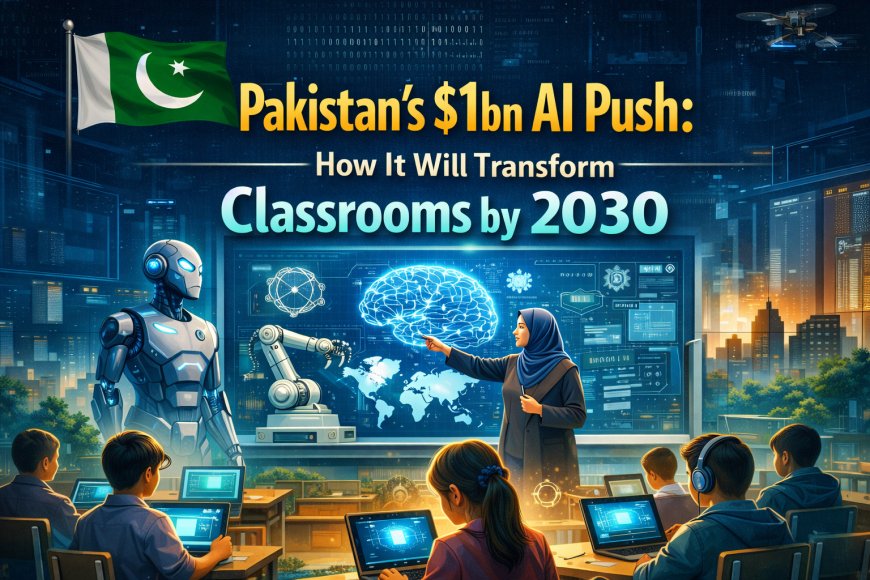
Pakistan is stepping into the future of education with a bold vision — investing $1 billion in Artificial Intelligence (AI) to reshape how students learn, teachers teach, and institutions operate. Announced under the leadership of Shehbaz Sharif, this initiative aims to prepare millions of students for a digital-first global economy.
But what does this really mean for classrooms, teachers, and students across Pakistan by 2030? Let’s break it down in simple, real-world terms.
🤖 Why Pakistan Is Investing in AI Education
The global education system is rapidly shifting toward automation, data-driven learning, and digital skills. To stay competitive, Pakistan plans to:
-
Train 1 million AI professionals
-
Modernize classrooms with smart technologies
-
Integrate AI into school and university curricula
-
Support innovation through research and startups
Key government bodies like Ministry of IT and Telecommunication and Higher Education Commission Pakistan are expected to play central roles in rolling out AI education policies.
📚 How Classrooms Will Change by 2030
1️⃣ Personalized Learning for Every Student
AI-powered platforms will analyze student performance and create personalized lesson plans.
Instead of one-size-fits-all teaching:
-
Weak areas will be automatically identified
-
Homework will adapt to individual learning speed
-
Students will get real-time feedback
👉 Result: Better learning outcomes and less academic pressure.
2️⃣ Smart Teachers, Not Replacement Teachers
AI won’t replace teachers — it will assist them.
Future classrooms may include:
-
Automated grading systems
-
AI lesson planners
-
Virtual teaching assistants
Teachers will spend more time mentoring and less time on repetitive tasks.
3️⃣ Virtual Labs & Immersive Learning
AI combined with VR/AR technology can create:
-
Virtual science experiments
-
AI-simulated medical training
-
Coding practice environments
Students from smaller cities will access high-quality learning resources without expensive labs.
4️⃣ Skill-Based Education Over Memorization
Pakistan’s AI push will likely shift focus toward:
-
Critical thinking
-
Problem-solving
-
Programming & data analysis
-
Real-world project learning
Companies like Google and other global tech organizations are already promoting digital-skill certifications — a trend that may expand through national programs.
💻 New Opportunities for Students
By 2030, Pakistani students could benefit from:
-
Free or subsidized AI & IT courses
-
Internship pipelines with tech companies
-
University-industry research collaborations
-
New careers in robotics, machine learning, cybersecurity
This shift could dramatically improve employability and freelance opportunities.
🏫 What Schools & Universities Need to Prepare
To make AI education successful, institutions must:
-
Upgrade internet infrastructure
-
Train teachers in AI tools
-
Update outdated curricula
-
Encourage project-based learning
Schools that adapt early will give their students a major advantage.
⚠️ Challenges Pakistan Must Overcome
Despite the promise, several hurdles remain:
-
Digital divide between urban and rural areas
-
Limited tech infrastructure in many public schools
-
Need for trained AI educators
-
Data privacy & ethical concerns
Solving these issues will determine how successful the AI transformation becomes.
🔮 The Big Picture: Pakistan’s Classrooms in 2030
Imagine a typical classroom in 2030:
-
Students learning through AI-powered interactive screens
-
Personalized dashboards tracking academic progress
-
Teachers using smart analytics to guide learning
-
Virtual labs accessible from anywhere in Pakistan
If implemented effectively, Pakistan’s $1 billion AI initiative could create one of the most modern, skill-focused education systems in South Asia.
✍️ Final Thoughts
Pakistan’s AI investment isn’t just about technology — it’s about preparing a new generation for the future. From personalized learning to smarter teaching tools, the classroom experience is set to evolve dramatically by 2030.
For students, this means more opportunities.
For educators, smarter tools.
And for Pakistan — a chance to build a globally competitive digital workforce.
What's Your Reaction?
 Like
0
Like
0
 Dislike
0
Dislike
0
 Love
0
Love
0
 Funny
0
Funny
0
 Angry
0
Angry
0
 Sad
0
Sad
0
 Wow
0
Wow
0