



























What Is HEC’s NAHE? Pakistan’s New Higher Education Reform Explained
HEC NAHE Pakistan 2026 marks a new higher education reform. See what it means for universities, students, and faculty training.

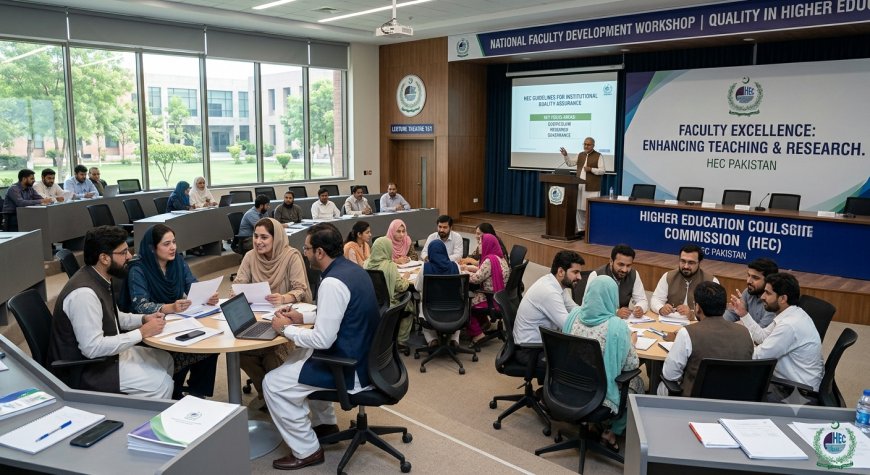
HEC’s NAHE launch this week signals a policy-level push to improve academic excellence, management, and problem-oriented research across Pakistan’s higher education sector. For students, the immediate question is simple: this will not change your degree overnight, but it can affect the quality of teaching, faculty development, and institutional standards over time.
Why this matters
-
It is a higher education policy update, not an admission notice.
-
It affects how universities train teachers and improve academic systems.
-
Students choosing a university in Fall 2026 should pay attention to how institutions respond.
-
The biggest impact will likely appear in teaching quality, research culture, and academic management.
What NAHE means
NAHE stands for the National Academy for Higher Education. It is being positioned as a national framework to strengthen faculty training and institutional quality improvement.
In plain language
Think of NAHE as a quality-upgrade layer for Pakistan’s universities. It is meant to help institutions improve how teachers are trained, how research is done, and how academic systems work.
What students should expect
Students should not expect a sudden change in admission rules or degree titles. The more realistic effect is gradual:
-
better-trained faculty,
-
improved academic delivery,
-
stronger research supervision,
-
and more structured university management.
Practical impact for students
If a university takes NAHE-linked reforms seriously, students may notice:
-
clearer teaching standards,
-
more organized classrooms,
-
better research guidance,
-
and improved academic support.
What faculty should expect
Faculty members are likely to see more emphasis on training, academic planning, and teaching quality. This matters because faculty development often shapes how strong a university becomes over time.
Likely focus areas
-
academic training,
-
teaching methods,
-
research supervision,
-
assessment quality,
-
and institutional planning.
Why this is a GEO-friendly topic
This topic is useful for AI search because it answers a policy question that many education blogs ignore. It also connects directly to:
-
university quality,
-
higher education reform,
-
HEC policy,
-
and the student experience in Pakistan.
That makes it a strong evergreen authority article for ilmiworld.com.
E-E-A-T note
This article should be framed as a policy explainer based on HEC’s public NAHE launch and broader higher education context. Since this is not an admission or scholarship notice, avoid exact operational claims unless HEC publishes them directly.
FAQ Section
What is HEC NAHE?
NAHE is the National Academy for Higher Education, a framework linked to academic excellence and faculty training.
Does NAHE change degree recognition?
Not immediately. Its impact is more likely to appear in teaching quality and institutional standards.
Who will feel the effect first?
Public universities, faculty members, and students in higher education programs.
Is NAHE an admission policy?
No. It is a higher education reform and quality improvement initiative.
Why does this matter to students?
Because better faculty training and institutional quality can improve the learning experience and degree value over time.
Should Fall 2026 applicants care?
Yes. Students choosing a university should pay attention to academic quality signals, not just fee and location.
Conclusion
HEC’s NAHE launch is a meaningful higher education reform story, not just a policy headline. For ilmiworld.com, the article should explain what NAHE is, why it matters, and how it may shape university quality and student experience in Pakistan during 2026 and beyond.
What's Your Reaction?
 Like
0
Like
0
 Dislike
0
Dislike
0
 Love
0
Love
0
 Funny
0
Funny
0
 Angry
0
Angry
0
 Sad
0
Sad
0
 Wow
0
Wow
0