





























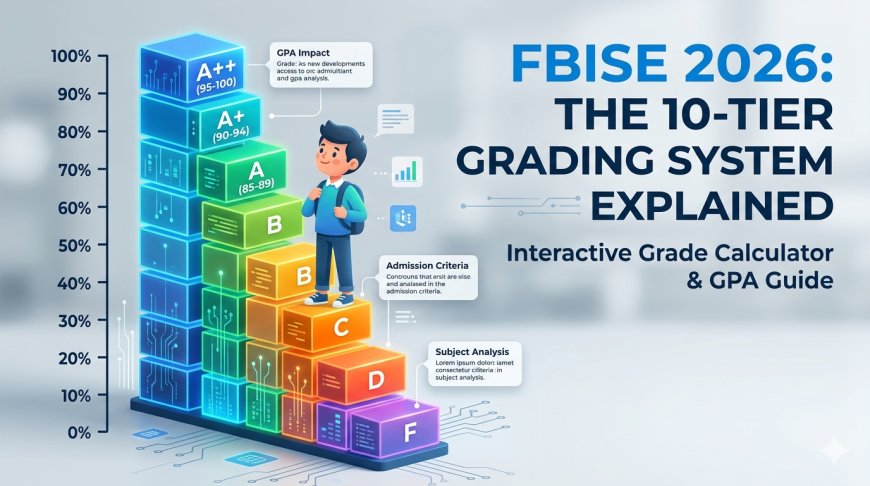
FBISE New Grading System 2026 Explained: What the 10-Tier Scale Means for Pakistani Students
FBISE has introduced a 10-tier grading system from 2026, replacing the old A–E scale. Passing marks are now 40%. Here's exactly what changed, why, and how it affects your SSC and HSSC result.

You studied hard all year. Now you're hearing there's a new grading system — and nobody's explaining it clearly.
That's the problem with big policy changes in Pakistan's education sector. The announcement comes, WhatsApp groups explode with half-understood information, and students are left guessing. Will your marks still show on your result card? Is the exam harder now? Will your grade affect university admission?
We'll answer all of that here, without the confusion.
What Is the FBISE New Grading System 2026?
The FBISE new grading system is a 10-tier grading scale that replaces the old 5-grade system (A, B, C, D, E). It takes effect from the First Annual Examinations 2026 for SSC-I and HSSC-I students. The minimum passing marks also changed from 33% to 40% per subject. This applies to students appearing in 2026 for Class 9 and Class 11.
The Federal Board of Intermediate and Secondary Education (FBISE) introduced the new 10-tier grading system following directives of the Inter Board Coordination Commission (IBCC), which approved the revised formula in its 182nd meeting held in August 2025. ProPakistani
This is not just a Federal Board change. All examination boards (private and public) in Pakistan are required to implement the new grading system from the First Annual Examination 2026, as per the resolution of the IBCC Forum. Ibcc
The Full FBISE Grade Scale 2026 — At a Glance
| Grade | Category | Marks Range |
|---|---|---|
| A++ | Extraordinary | 96–100% |
| A+ | Exceptional | 91–95% |
| A | Outstanding | 86–90% |
| B++ | Excellent | 81–85% |
| B+ | Very Good | 76–80% |
| B | Good | 71–75% |
| C+ | Fairly Good | 61–70% |
| C | Satisfactory | 51–60% |
| D | Pass | 40–50% |
| E / Ungraded | Fail | Below 40% |
The FBISE replaced the old five-grade structure (A, B, C, D, E) with this new performance-based grading scale, expanding it to 10 distinct levels. DialoguePakistan
Why Did Pakistan Change the Grading System?
Pakistan's old board exam system had a real problem: a student scoring 945/1100 and one scoring 943/1100 were treated almost identically. The difference of 2 marks could tip someone off a merit list, causing enormous stress and — frankly — a culture of fighting over fractions of percentage points.
While the change may not significantly affect high-performing students, it will increase pressure on those who rely on the bare minimum to pass. Gulf News That's a fair point. But the broader goal is alignment with global standards.
The IBCC's FAQ frames this shift as a way to reduce psychological pressure and competition culture. Marks create unhealthy competition — "I got 945, you got 943." Grades group students into performance bands. Roz New
The second goal is to push students away from rote memorisation toward concept-based learning. If you're in the "B" band whether you scored 71% or 75%, the incentive shifts from chasing exact marks to understanding the subject.
What Does the Change in Passing Marks Mean?
This is the part that worries students most. Let's be direct.
Old passing mark: 33% per subject New passing mark: 40% per subject
If you scored 35% in any single subject under the old system, you passed. Under the new system, you don't. That's a real difference, especially for students who scrape by in subjects like Mathematics or Physics.
The minimum pass percentage has been set at 40%, which is intended to encourage students to focus more on their studies and achieve a better understanding of their subjects. Daily Ausaf
What this means practically: if you're a Class 9 or Class 11 student right now, you need to score at least 40% in every single subject — not just the overall aggregate — to avoid a supply exam (compartment). Study all subjects. Don't sacrifice one thinking you'll pass overall.
Does the New System Affect the Paper Pattern or Marking?
No. The paper pattern, question difficulty, and marking scheme remain the same. Only how your final marks are reported changes.
The new grading system will not affect the paper pattern, marking scheme, or level of difficulty of the examination. The conduct and administration of the examination will also remain the same. Ibcc
So the exam isn't harder. It just reports results differently.
Does This Change Affect University Admissions?
For now, the impact on admissions is limited — but it's changing.
From 2026–2027, universities may refer to grades provided by the examination boards, or they may continue using raw scores for admission purposes. However, after adoption of the grading scheme by all boards — tentatively from 2029 — all colleges and universities will refer to CGPA only for admissions, as raw marks will not be shown on the mark sheet. Ibcc
Translation: for MDCAT, ECAT, and NET preparation cycles in 2026, universities will still look at your raw marks and percentages. Grades become the dominant metric from around 2029. But it's a good idea to start thinking in terms of grade bands now, since that's where the system is heading.
Which Students Does This Apply to in 2026?
| Exam Level | Effective From |
|---|---|
| SSC-I (Class 9) | First Annual Exam 2026 |
| HSSC-I (Class 11) | First Annual Exam 2026 |
| SSC-II (Class 10) | First Annual Exam 2027 |
| HSSC-II (Class 12) | First Annual Exam 2027 |
If you're appearing in Matric (Class 10) or Inter Part 2 (Class 12) in 2026, the new grading system does NOT apply to you yet. It applies from 2027 for those levels. Your 2026 result will still show under the old system.
How Should Students Prepare Under the New System?
The goal hasn't changed: learn your subjects well. But here are three practical shifts to make:
1. Aim for grade bands, not individual marks. If you're at 78%, you're B+. A 3% jump takes you to B++ (81%). That's a realistic, motivating target.
2. Focus on subjects where you're near a failing threshold. Getting 38% is no longer enough. Make sure every subject clears 40%.
3. Don't over-focus on practicals — but don't ignore them. For some streams, practical-based subjects may have different theory/practical weightings. If your subject includes a practical, treat it like a main scoring area, not a side activity. Roz New
Will Provincial Boards (Punjab, Sindh, KPK) Also Change?
An FBISE official said during the IBCC meeting, all examination boards of the country had agreed to adopt the revised grading system and new passing marks formula — however, it is yet to be seen whether they will all implement it or not. Dawn
While FBISE has adopted the new policy, the education boards of Sindh, Punjab, Khyber Pakhtunkhwa, and Balochistan have yet to formally follow suit, though Sindh is in the process of approving the new grading policy. Daily Ausaf
Bottom line: FBISE students are definitely affected from 2026. For provincial boards, follow your own board's official notifications. Don't rely on rumors.
FAQs: FBISE New Grading System 2026
Q: When does the FBISE new grading system start? It starts from the First Annual Examinations 2026 for Class 9 (SSC-I) and Class 11 (HSSC-I). For Class 10 and Class 12, it starts from 2027.
Q: Is the new system harder than the old one? The exam difficulty is the same. Only the minimum passing marks (now 40%) and the way grades are reported have changed.
Q: Will my marks still show on my result card? Yes, for now. Marks will still appear alongside grades. From approximately 2029, only CGPA may show on mark sheets.
Q: What happens if I score below 40% in one subject? You'll receive an Ungraded (E) result for that subject and will need to appear in a supply (compartment) exam.
Q: Does the new grading system affect O/A-Level students? No. The FBISE reform applies to SSC and HSSC students only. O/A-Level results follow Cambridge's own system.
Q: Will MDCAT and ECAT merit still use percentage marks? Yes. For 2026 entry tests, merit calculations continue to use raw percentage marks. The shift to CGPA-only admissions is expected around 2029.
References and Citations
- FBISE Official Notification (October 7, 2025) — fbise.edu.pk
- IBCC New Grading System FAQs — ibcc.edu.pk/faqs/new-grading-system-of-ssc-hssc-faqs
- Dawn News Report on FBISE Grading Change — dawn.com/news/1947346
- TechJuice Coverage — techjuice.pk
- Pakistan Education Update 2026 — roznew.com
What's Your Reaction?
 Like
0
Like
0
 Dislike
0
Dislike
0
 Love
0
Love
0
 Funny
1
Funny
1
 Angry
0
Angry
0
 Sad
0
Sad
0
 Wow
0
Wow
0
Related Posts



-
 Ahmed razaPlease let me