









Punjab Mandatory Teaching License 2026: Full Guide for Teachers & Students
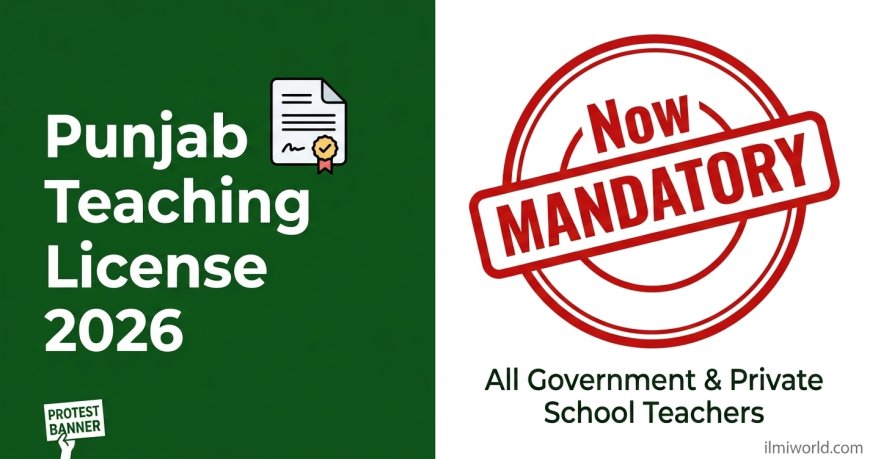
Punjab has made teaching licenses mandatory for all government and private school teachers. Learn what the test covers, the 3 license levels, who is affected, and why teachers are protesting in 2026.

|
Quick Answer — Punjab Teaching License 2026 Policy: Mandatory for all government and private school teachers in Punjab License Levels: Three — Primary, Elementary, Secondary Test Covers: School subjects, general knowledge, IT skills License Validity: 5 years (renewable after re-testing) Consequence of Non-Compliance: Removal from service; contract extensions denied Enforced By: Punjab School Education Department (current academic year) Opposition: Punjab Teachers Union, Educators Association, Headmasters Association Education Minister: Rana Sikandar Hayat — defended the policy |
Punjab Mandatory Teaching License 2026: What It Means for Teachers and Aspiring Educators
If you are planning a career in teaching — or if you already have a teacher in your family — this policy will directly affect your future. Punjab's School Education Department has made a professional teaching license mandatory for all teachers across the province. Government school teachers, private school educators, and even contract staff must now obtain this license or face removal from service.
This move is one of the most significant shifts in Punjab's education system in years. It has also triggered strong opposition from teachers' associations across the province, who argue the policy undermines the value of degrees like B.Ed, M.Ed, and MPhil that teachers have already earned.
We break down everything you need to know — what the license is, how it works, who is affected, what the controversy is about, and what this means if teaching is your career goal.
What Is the Punjab Mandatory Teaching License?
The Punjab teaching license is a professional certification that all school teachers in the province must hold to teach legally. Think of it like a driving license — but for the classroom. That is exactly the comparison Education Minister Rana Sikandar Hayat used when defending the policy.
Under this system, every teacher — whether serving in a government school or a private institution — must pass a standardized test to earn their license. Teachers who do not obtain the license face removal from service. Contract teachers will not receive extensions without it.
The policy is being enforced during the current academic year (2026). The Punjab School Education Department announced it after years of concerns about inconsistent teacher quality and classroom performance across the province.
Three Levels of the Punjab Teaching License
The license is not one-size-fits-all. Punjab has structured it into three distinct levels based on the class range a teacher works with:
|
License Level |
Who It Covers |
School Classes |
|
Primary |
Primary school teachers |
Classes 1 to 5 |
|
Elementary |
Middle school / elementary teachers |
Classes 6 to 8 |
|
Secondary |
High school teachers |
Classes 9 to 12 |
Each teacher will be tested and licensed at the level matching their teaching assignment. If you teach across multiple levels, you may need to qualify separately for each. The license stays valid for five years, after which teachers must renew it through re-testing.
What Does the Punjab Teaching License Test Cover?
The licensing test is designed to evaluate three core areas of teacher competency:
1. Subject Knowledge
Teachers are tested on the subjects they actually teach. A mathematics teacher will face maths-focused questions. A science teacher gets science questions. This tests whether the teacher genuinely understands the content they are expected to deliver to students.
2. General Knowledge
A section on general knowledge and awareness covers current affairs, civic awareness, and Pakistan-specific context. This ensures teachers can connect classroom learning to the broader world.
3. IT Skills
This is the most forward-looking part of the test. Teachers must demonstrate basic digital literacy — using computers, educational software, and technology tools that are now standard in modern classrooms. The government wants teachers who can use technology, not just textbooks.
|
Note on Administering Body As of May 2026, the Punjab Examination Commission (PEC/PECTA) is named as the oversight body for the licensing process. The specific agency responsible for conducting the test has not been fully finalized. Watch official announcements from the Punjab School Education Department for the confirmed testing schedule and registration details. |
Who Is Affected by This Policy?
The reach of this policy is wide. Here is a clear breakdown of who it covers:
|
Category |
Affected? |
Details |
|
Government school teachers (all subjects) |
Yes |
Must obtain license to continue service |
|
Private school teachers |
Yes (phased) |
Government will expand to private sector after consultations |
|
Contract teachers |
Yes |
License required for contract renewal/extension |
|
Newly recruited teachers |
Yes |
No recruitment without a valid license |
|
Promotions (existing teachers) |
Yes |
Future promotions tied to license validity |
|
Teachers with B.Ed / M.Ed / MPhil / PhD |
Still required |
Degrees do not exempt from licensing test |
This last point is the biggest source of controversy. Teachers who already hold CT diplomas, B.Ed degrees, M.Ed qualifications, MPhils, and even PhDs are still required to sit this test. For many experienced educators, that feels deeply insulting.
Why Are Teachers Protesting? Their Side of the Story
Teachers' associations across Punjab have rejected the policy outright and announced protests. The opposition is coming from three major organizations: the Punjab Teachers Union, the Educators Association, and the Headmasters Association.
Their leaders — including Dr. Sagheer Alam, Rana Liaqat, Akhyan Gul, Basharat Iqbal Raja, and Mohammad Shafiq Bhaluwalia — have made the following arguments against the policy:
Argument 1: It Disrespects Existing Qualifications
Teachers who spent years and significant money earning CT diplomas, B.Ed degrees, M.Ed, MPhil, and PhDs now find those qualifications treated as insufficient. The associations say requiring a license on top of these degrees shows a lack of trust in formally educated professionals. As they put it, the officials imposing this requirement were themselves taught by the very teachers now being questioned.
Argument 2: Education Is Becoming a Laboratory
Teachers warn against what they call turning the education system into a "laboratory for experiments." The concern is that each new government rolls out a major reform without consulting the teachers who will implement it, creating instability in the system.
Argument 3: Privatization Concerns
Some teacher leaders have alleged that the licensing requirement is part of a broader push to privatize public schools. They fear that teachers who fail the test will lose jobs, creating vacancies that private institutions or contracted services will fill.
Argument 4: Removal Threat Is Too Harsh
The policy links non-compliance to removal from service. Teachers argue that removal is an extreme response for experienced professionals who may struggle with a new test format — not because they cannot teach, but because test-taking and classroom teaching are entirely different skills.
The Government's Position: Why Punjab Thinks This Is Necessary
The Punjab School Education Department and Education Minister Rana Sikandar Hayat stand firmly behind the policy. Their reasoning centers on several key points:
• Teacher accountability: Years of concerns about inconsistent classroom performance across Punjab have built pressure for a measurable standard.
• Uniform quality: With hundreds of thousands of teachers across public and private schools, qualifications currently vary widely. A licensing test creates one consistent bar.
• Professional parity: Doctors, engineers, and lawyers must hold licenses to practice. Teaching — responsible for shaping the next generation — should carry the same professional standard.
• IT readiness: Pakistan's classrooms need digitally capable teachers. The IT component of the test ensures no teacher is left behind on this front.
• Student outcomes: The government believes that a licensed, tested teacher workforce will directly improve learning results for students — which is the ultimate goal of any education system.
The minister's comparison to a driving license is deliberate. You cannot legally drive without proving you can handle a vehicle safely. The same logic, the government argues, should apply to someone responsible for educating thousands of children.
What Does This Mean for Students Aspiring to Become Teachers?
If you are a student thinking about a career in teaching — or currently enrolled in a B.Ed, M.Ed, or education program — this policy changes the landscape for you. Here is what to keep in mind:
Your degree is still necessary, but not sufficient
A B.Ed or M.Ed remains a requirement for teaching jobs in government schools. But from now on, it is the starting point, not the finish line. You will also need to pass the teaching license test. Think of the license as a third step: degree plus B.Ed or M.Ed, and then the license test.
IT skills are non-negotiable
The licensing test includes an IT skills component. If you are currently in an education program, start building your digital skills now. Basic skills like using MS Office, educational platforms, and online communication tools will be tested. The teachers who invest in digital literacy today will have a clear advantage.
The license will be your career key
Once the system is fully operational, no government or private school will legally hire a teacher without a valid license. This means the license becomes the single most important credential for a teaching career — even above your degree. Plan your career timeline around it.
Renewal every five years
The license is valid for five years. After that, you need to renew it. This means teaching will be a profession that requires ongoing learning and periodic re-evaluation — which is actually a good thing for long-term professional growth.
How Does This Compare to Other Countries?
Pakistan is not doing anything unusual here. Teacher licensing is standard practice in many countries:
|
Country |
Teaching License Requirement |
Validity |
|
United Kingdom |
Qualified Teacher Status (QTS) — mandatory |
Lifetime (with continued professional development) |
|
United States |
State teaching license / certification — mandatory |
3–5 years (varies by state) |
|
India |
Teacher Eligibility Test (TET) — mandatory for govt. schools |
7 years |
|
Australia |
Teacher registration — mandatory in all states |
Annual renewal |
|
Malaysia |
Guru Cemerlang certification — mandatory for senior teachers |
5 years |
|
Punjab, Pakistan (2026) |
Teaching license — mandatory for govt. and private schools |
5 years |
The idea itself is globally accepted. The challenge in Punjab is the implementation — specifically, the absence of a clear support framework for existing teachers who must now sit an exam alongside their full teaching workloads.
Timeline: Where Does This Stand Right Now?
Here is a summary of how this policy has developed and where things stand today:
|
Date |
Development |
|
November 2025 |
Punjab School Education Department announces mandatory teacher licensing plan; summary sent to Provincial Cabinet for approval |
|
Early 2026 |
Policy formalized; PEC/PECTA named as oversight body |
|
April 23, 2026 |
Teachers' associations announce rejection of policy; protests declared; Punjab Teachers Union, Educators Association, Headmasters Association oppose officially |
|
May 2026 |
Policy enforcement confirmed for current academic year; private school expansion announced as next phase |
|
Coming Months |
Exact test schedule, registration process, and administering body to be officially announced by Punjab School Education Department |
We will update this article the moment the Punjab School Education Department announces the licensing test schedule. Bookmark ilmiworld.com for live updates.
|
E-E-A-T Verification Note All policy details in this article are sourced from Pakistan Today (April 23, 2026), ProPakistani (November 28, 2025 and April 23, 2026), TechJuice, and official statements by the Punjab School Education Department. Teacher association names, leader names, and quotes are verified from primary news reports. ilmiworld.com publishes Pakistan education policy coverage for students aged 16-24. Last verified: May 25, 2026. |
Frequently Asked Questions — Punjab Teaching License 2026
Q1. Is the teaching license mandatory for private school teachers in Punjab too?
Yes. The Punjab School Education Department has confirmed that the license will apply to private school teachers as well. However, the government plans to extend the requirement to the private sector in a phased manner, after consultations with private school stakeholders. Government school teachers are the first group being required to comply during the current academic year.
Q2. What subjects are covered in the Punjab teaching license test?
The test covers three areas: the subject the teacher actually teaches (for example, mathematics or biology), general knowledge, and IT skills. The exact syllabus and question breakdown have not been officially released yet. We will publish the full syllabus as soon as the Punjab School Education Department issues the official notification.
Q3. What are the three levels of the Punjab teaching license?
The license has three levels. The Primary level covers teachers of Classes 1 to 5. The Elementary level applies to teachers of Classes 6 to 8. The Secondary level covers teachers of Classes 9 to 12. Each teacher must obtain the license at the level matching their assigned teaching range, with a validity of five years for each.
Q4. What happens to a teacher who does not get the teaching license?
According to the policy, teachers who do not obtain the license face removal from service. Contract teachers will not receive extensions without a valid license. Future recruitment and promotions will also be limited to licensed teachers. This is the aspect of the policy drawing the strongest opposition from teachers' associations.
Q5. Why are Punjab teachers protesting against the mandatory license?
Teachers' organizations argue that requiring a license alongside existing qualifications — such as CT diplomas, B.Ed, M.Ed, MPhil, and PhD degrees — shows a lack of confidence in the teaching profession. They also raise concerns about the removal threat, the risk of privatization of public schools, and the lack of consultation with teachers before announcing the policy. The Punjab Teachers Union, Educators Association, and Headmasters Association are leading the opposition and have announced formal protests.
Q6. Does the Punjab teaching license replace B.Ed or M.Ed degrees?
No. The teaching license does not replace B.Ed, M.Ed, or any other education degree. These degrees remain a prerequisite for teaching jobs. The license is an additional requirement on top of your academic qualifications. So if you plan to teach in Punjab, you will need your degree AND the teaching license. Both are required.
Our Take: What Students and Aspiring Teachers Should Do Now
The Punjab teaching license policy is happening — protests or not. Governments rarely reverse decisions of this scale once enforcement begins. If your career goal is teaching, the smart move is to prepare now rather than wait for all the details to be finalized.
Start building your IT skills today. Review your subject knowledge. And stay connected to official updates from the Punjab School Education Department.
We will cover every update on this policy — the test schedule, registration process, syllabus, and protest developments — as they break. ilmiworld.com covers all Punjab education news the moment it becomes official.
What's Your Reaction?
 Like
0
Like
0
 Dislike
0
Dislike
0
 Love
0
Love
0
 Funny
0
Funny
0
 Angry
0
Angry
0
 Sad
0
Sad
0
 Wow
0
Wow
0